
The Ultimate Guide to Tension Set Diamond Rings
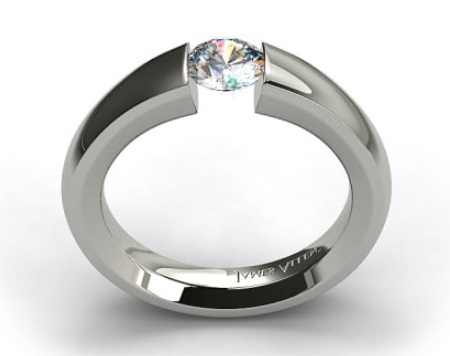
A sleek, contoured tension set diamond ring setting.
If you are looking for the type of design that will make your engagement ring stand out, look no further than the tension setting. But, what makes tension set diamond rings so special?
Unlike traditional rings that utilize prongs or metal baskets to secure a center stone, a tension ring uses compression pressure to hold the diamond in place without any metal prongs. This creates an intriguing appearance where the diamond appears to be floating in mid-air.
In this write up, we will look at the pros and cons of the tension setting and reveal the things you need to look out for when shopping for one. We will also review some of the best tension set diamond rings designs and where you can buy them.
Let’s dive right in…
Here is a list of topics we will be covering:
What is a Tension Set Diamond Ring?
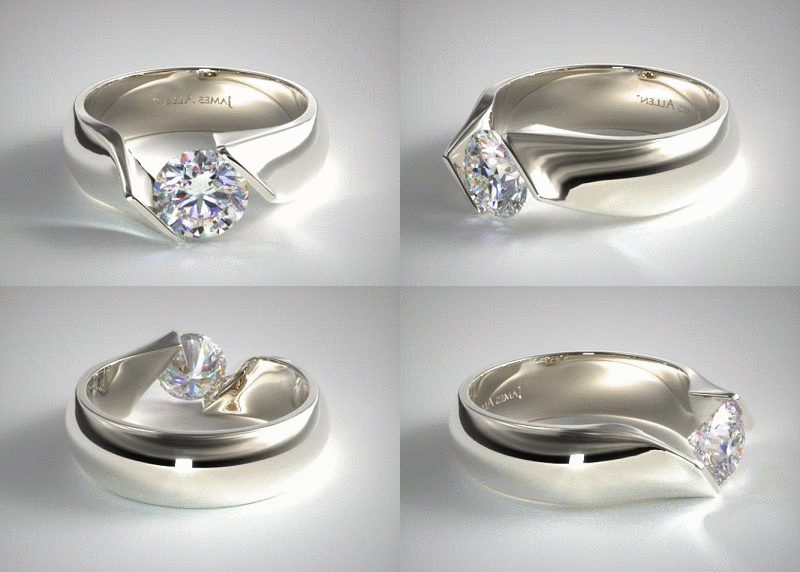
Tension setting with 1ct round diamond.
In a tension setting, the diamond is placed in an opening of the ring and held in place by pressure exerted from the open ends. Basically, you could imagine the metal setting behaving like a mechanical clamp that’s being used to secure an object between its jaws.
Due to this “invisible” compressive force, there isn’t any metal beneath or surrounding the diamond and this forms the basis of a tension ring’s amazing looks. To the observer, the diamond appears to be “floating” between the 2 sides of the ring.
To the uninitiated consumer, a tension setting engagement ring may look fragile because of the apparent lack of mechanical support. But in reality, tension rings are very durable and highly secure when they are made with good craftsmanship.
Tension Set Rings Pros And Cons
To help you get a better understanding of tension rings, let’s take a look at the pros and cons they have.
What Are the Advantages of Buying a Tension Set Ring?
#1 – They create intrigue and can easily become a conversation starter because of the dramatic looks they display. It gets people thinking about how the feature diamond stays in place since it is “magically floating” without any support.
#2 – Tension settings often have a modern and futuristic design. They can be created using metals that are commonly used in jewelry (i.e. yellow gold, white gold, sterling silver, platinum, and palladium) and can also be custom made for fancy diamond shapes like pears and ovals.
#3 – A tension ring enables the diamond to be seen in full view from more angles compared to other types of setting methods. This allows more light to hit the diamond and enhances its brilliance.
#4 – They are extremely easy to clean and maintain.
What Are the Disadvantages of Buying a Tension Set Ring?

#1 – While a ring may fit your finger when it was initially purchased, it might not hold true several years down the road. As people age, our finger size can change and rings may have to be resized to stay correctly fitted.
The biggest problem with tension rings is that they cannot be easily resized compared to other types of settings. This is because they are crafted and calibrated to exact measurements based on the size of the center stone.
#2 – The majority of tensile setting diamond ring designs are usually thick and bulky looking. They are deliberately designed this way as thicker shanks provide the necessary mechanical strength for the tensile setting to work.
#3 – Due to the bulkier setting designs, the center diamond can appear to look smaller than it is.
#4 – Tensile settings can cost significantly more because of the niche market and specialized skillsets required to make them.
Best Tension Diamond Engagement Ring Designs
When tension rings were first created back by a German company called Niessing in the 1970s, they were bulky and gaudy looking. At that time, tension rings didn’t gain much popularity because they looked too “manly”.
Fast forward to present day, modern day tension ring designs span a wide range of styles due to improved manufacturing techniques and availability of high-tech equipment. Let’s check out some of the best tension setting engagement ring designs in the market.
Feel free to click on the images to view the listings in full details…
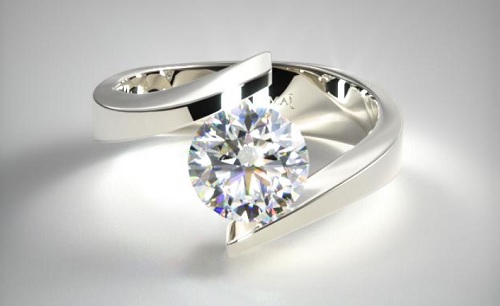
This dramatic looking spiral tension set engagement ring allows you to view the center stone with minimal obstruction. With a sleek looking curvature, this is a contemporary ring design that will make a bold fashion statement.
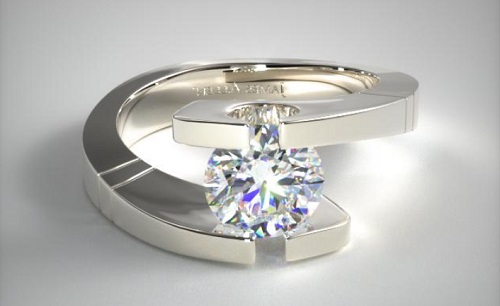
This wonderful setting offers a clean, polished appearance that is extremely unique. Whether you choose a round or a marquise shaped diamond as the center stone, it is going to turn heads and make people go “Wow!”.
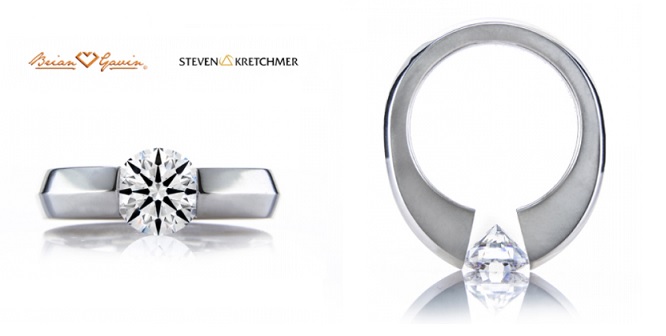
Steven Kretchmer is a legendary jewelry designer that specializes in tension settings. The diamond in this classic tension ring is suspended by the setting under a force of 12,000 pounds per square inch to hold it securely.
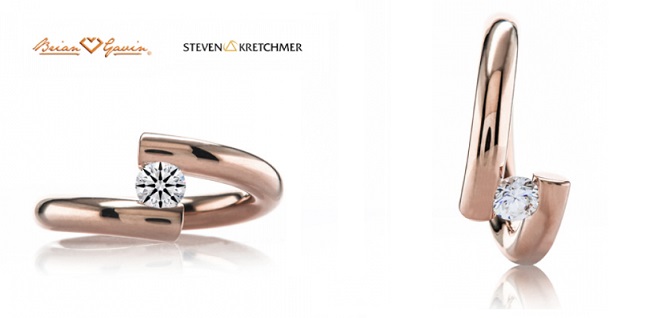
For people who want a more sleek and elegant tension design, this beautiful rose gold design has an intriguing appearance that will look great on smaller hands. It’s also available in 18k white gold and platinum.
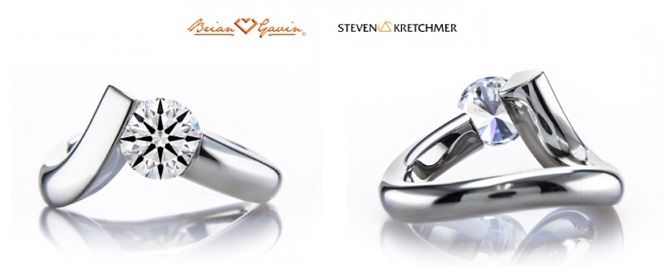
This captivating V-ring is designed creatively to give the engagement ring a playful twist and appeal. It also has a matching wedding band that complements the engagement ring perfectly.
Unique 2 Tone Metal Tension Ring Mountings
Perhaps the boldest tension set ring design manifests itself in the form of using different colored metals. I personally find these designs really awe-inspiring to look at. If you have fair colored skin tones, these might be fantastic options to consider.
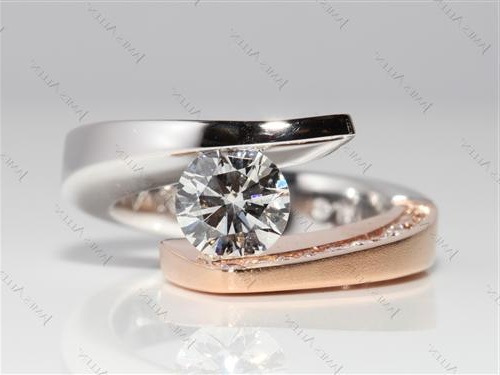
This design has a perfect balance of rose gold and white gold to create color contrast.
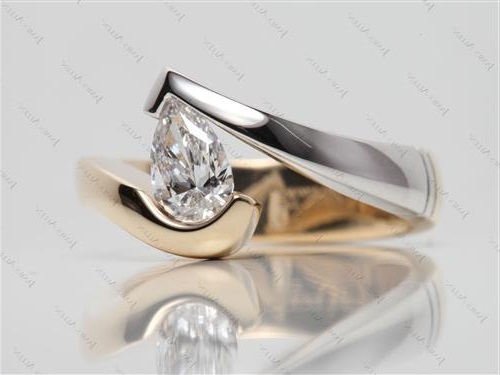
Built for fancy shapes, this tension ring design has a lovely combination of white and yellow gold.
Frequently Asked Questions About Tension Mount Rings
Question: What is the best metal (14k white gold, 18k white gold or platinum) to choose for a spiral tension set engagement ring?
Answer: All of those metals above would work for tension rings. Technically speaking, 14k white gold would be the hardest metal and logically, be the best metal for better strength and durability.
However, modern manufacturing techniques have allowed jewelers to create rings with equally good reliability across the different types of metals.
Question: I have a question about the diamond getting loose or rotating within the pieces of metal. If I were to use a lot of force with my finger to turn and rotate the diamond in the setting, would it be able to rotate at the points where it is held at the girdles?
Answer: In a tension mounting, there are little notches or grooves that are cut into the mounting and the diamond’s girdle sit snugly before it is “clamped” in place under high-pressure forces. If you tap, lightly twist or tug the diamond using your fingers with reasonable force, you won’t be able to wedge or move it at all.
Question: Are there any thin shanks or dainty looking tension ring designs? Most of those that I had come across look too gaudy and big for my fingers.
Answer: Unfortunately, most tension settings are wider and taller because they need the mechanical strength to grip the gemstone securely. I would be wary of tension settings that feature overly thin shanks!
Question: Can you resize a tension setting?
Answer: No. This is the main disadvantage of tension engagement rings as it is impossible to resize them without causing damage to the ring. If you need a resize, a new ring would have to be made.
Let’s Wrap Things Up: Where to Buy Tension Engagement Rings?
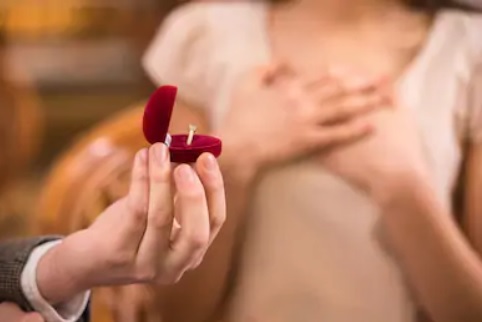
As we have seen, modern tension settings often have one-of-a-kind designs that can create spectacular visual impact. If you are someone who likes a modernistic look in your diamond ring or wants to make a bold fashion statement, they will be perfect for you.
Tension rings aren’t easy mountings to work with and they require highly skilled labor and tools to create reliable settings. Because of these reasons, you have to be very selective of whom you work with.
I highly recommend reliable vendors like James Allen and Brian Gavin if you are shopping for a tension set engagement ring. Both vendors offer a superb collection of high quality GIA/AGS certified diamonds and have a wide range of ring designs for you to choose from.
Related Articles

About The Website:

Leave A Comment
Latest Posts From Our Blog


Join Us On Social Media!



Visit The Gallery For Ideas!


12 Comments
very informative article. keep posting such great stuff. is resizing suspension diamond engagement rings really impossible? when it comes to tension set rings pros and cons, do you think the benefits outweigh the risks?
It’s not impossible but it’s extremely hard to do it reliably and for skilled craftsmen that can, you can expect your bill to be extremely large. Most of the time, it’s just not worth it and it would be better to get a new ring from scratch.
It depends on what you are looking for. A tension mount diamond ring can offer a look that other styles cannot achieve. Most of the unwarranted fear comes from a suspension engagement ring being unsafe and that’s a misconception. They are as safe as prong set rings and if you practice some common sense when wearing them, they will last a lifetime.
We have tension mountings from Gelin Abaci in stock and we are looking for a company that will do the sizing and setting of the stones since Gelin Abaci is out of business. Can you recommend someone? Thanks.
I don’t know anyone reliable who could do this. You are basically out of luck here as there are some liabilities with tension settings. If the OEM is out of business, selling them to consumers puts your business at risk.
Thanks for the really clear and comprehensive write up about tensile ring settings. Have you heard of Steven Kretchmer and can you do a review of their tension mount rings?
*The main article was updated to include some of Steven Krethmer’s ring designs after this comment was posted.
Yes. Here’s a bit of history. Tension rings were first created by a German company called Niessing, Their bulky designs were an engineering solution to provide sufficient mechanical strength to grip the diamond securely.
Even though suspension engagement rings didn’t take off in popularity with consumers, it captured the interests of jewelers around the world. One American jeweler named Steven Kretchmer was among the first few people to adopt the design in the States. With an innovative mind, Steven improved on the manufacturing process by reducing weight in the rings and redesigned the new tension set rings with a more feminine touch.
Since then, technology advanced and manufacturing capabilities improved with better machinery. In modern times, tension set rings come in many designs and are making a statement that keeps people in awe with their out-of-this-world appearances.
From what I read and researched, the strength of a tension setting is largely affected by the metals used. Is white gold or yellow gold better? Is the recipe for these metals public or a trade secret?
The exact recipe that different jewelers used are a trade secret to them. I would say this, it is relatively easy to reverse engineer and find out the composition using modern day testing equipment. For tension ring sellers, I’m pretty sure that most have already tested and perfected their manufacturing recipe prior to going into business. So, both yellow and white gold would work well and it really is a matter of color preferences here.
My Gelin Abaci diamond ring is too small for me now – I see from your site that they are out of business. What would you do? Is there any option to take it apart and have a different one made? I’m just sick about it – Thanks for your thoughts…Kathy
If you bought it from a jeweler (that’s still around), bring it back to them and let them know your concerns. Even if the brand has closed down for business, you should be able to get the bench jeweler to remove the diamond from the setting and get it reset.
Do you have any recommendations for tension style engagement rings and what are the things to look out for when buying a faux tension setting?
I hope you are not looking to buy a knock off replica or trying to get a cheap “discounted” tension ring because quality matters a lot! You want to get a proper tension setting from a reliable vendor if you don’t want to risk your diamond dropping out or getting lost.
If I am getting your question correctly, you are asking about buying a ring design that looks like a tension ring but actually has a metal band that cups or supports the diamond on its base. I get that not everyone would be comfortable with a traditional tension setting engagement ring as there could be some practical concerns. For tension style or faux suspension engagement rings, James Allen and Brian Gavin are also great places to buy them as their workmanship is superb.
Here are a few examples to check out:
https://www.briangavindiamonds.com/engagement-rings/spiral-of-love-18k-white-gold-5380w18
https://www.jamesallen.com/engagement-rings/tension/14k-white-gold-hand-engraved-bypass-engagement-ring-item-52615