
The Complete List of Diamond Inclusion Types
When it comes to buying a diamond ring, clarity is an aspect that many consumers find confusing. In this write up, I’ve compiled a list of the different types of inclusions in diamonds to show you what they mean and how they look like.
With the use of images and videos (photography credits – James Allen), I hope you get a better idea of identifying diamond flaws and understanding the visual impact an inclusion may have on the diamond’s appearance.
Bearding – Hair-like inclusions that form at the girdle area due to improper bruting processes. A heavily bearded girdle with a grey fuzzy appearance should be avoided.
Graining – Caused by irregular crystal growth. Internal graining can appear like whitish, colored or reflective lines. Depending on the severity, they can also look like creases or give the diamond a hazy appearance.
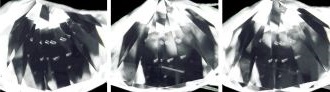
Image credits: Vincent Cracco, © GIA
Cavity – This usually takes the form of a large or deep opening in the diamond’s surface. Cavities can be created during the polishing process when an internal inclusion like a crystal falls out of its pocket and leaves behind a void. Read this article for more insights.
Crystals – Included minerals that exist within the body of the diamond. Depending on the type of minerals they are, crystals can be colorless (possibly an embedded diamond!), black (carbon), reddish (garnets), greenish (peridots) and etc…
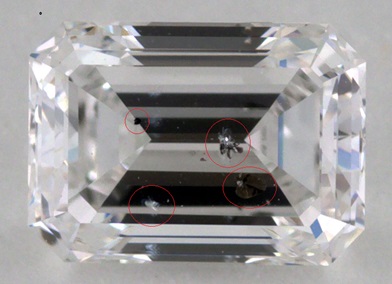
Crystals can exist in different kinds of shapes and colors.
Colored crystal inclusions are much more obvious to the naked eye and they are generally undesirable. Vice versa, a colorless or transparent crystal inclusion would have less impact on the diamond’s appearance.
Cloud – A cloud inclusion is a very broad term used to classify a cluster of pinpoints/crystals found very close to each other. Depending on the nature of the cloud inclusion, it can sometimes pose an issue to the diamond’s transparency.
For example, when clouds get too big in size and density, they can cause the diamond to take up a hazy appearance and negatively affect its light transmission properties. If they are small and diffused, it generally isn’t a cause for concern.
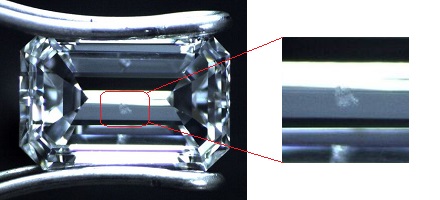
This dense and visible white cloud sets the clarity grade in this SI1 emerald cut.
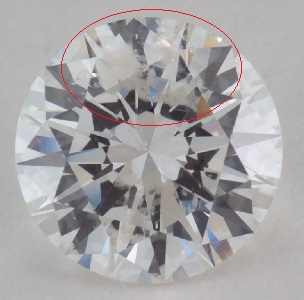
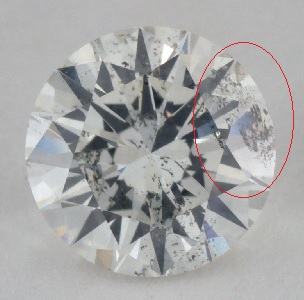
Varying intensities and coloration of cloud inclusions.
Feather – A small crack or fracture within the diamond. Depending on your viewing angle, a feather can look transparent and almost invisible or it can catch on light and display an opaque appearance.
Severe feathers can cause durability issues (especially if they are surface reaching or near the girdle area) or have unsightly coloration to them; both of which should be avoided.
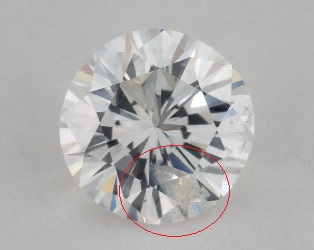
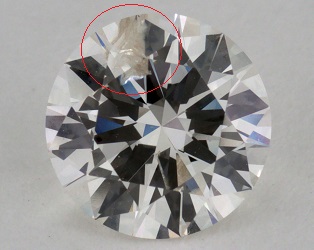
In both the examples above, the size and location of the massive feather near the girdle poses additional risks of the diamond being chipped. The feathers also have a grey and brownish coloration respectively and they are very obvious to the naked eye.
Needle – A long thin needle-shaped (tiny-rod) inclusion that is usually white or transparent in color. If they appear in clusters, it might affect cause a detrimental effect on the diamond’s clarity.
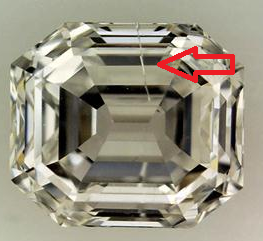
Super obvious needle that runs across the middle of the stone.
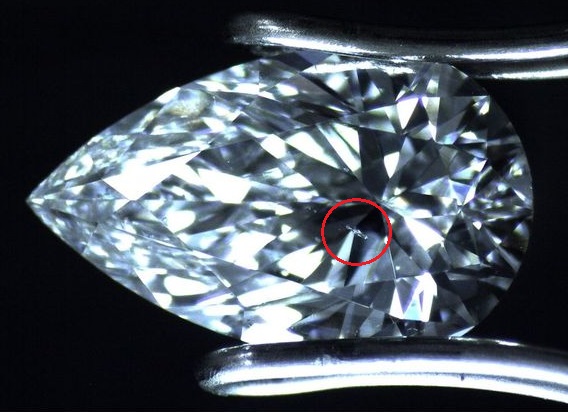
Small, transparent and elongated needle under the pear’s table facet.
Pinpoints – These are tiny white or black crystals that are embedded inside a diamond. Out of all the different kinds of inclusions found in a diamond, pinpoints can be considered the most benign.
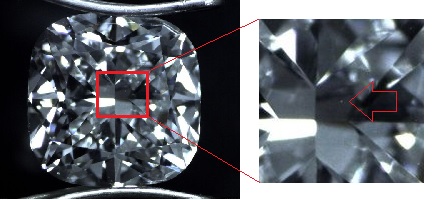
Can you see the faint white pinpoint?
Twinning Wisps – This inclusion is a result of growth defects (distortion) in a diamond’s crystal structure. In essence, twinning wisps are a mish-mash of different inclusions such as pinpoints, crystals, feathers and clouds.
They often resemble a twirly looking plane and appear ribbon-like. In rare cases, they can show a slight yellow or brown coloration which makes them look like thin reflecting surfaces inside the stone.
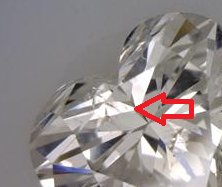
Faint twinning wisp that can hardly be made out to the unaided eyes.
This video shows a heavily twinned heart cut with an I1 clarity.
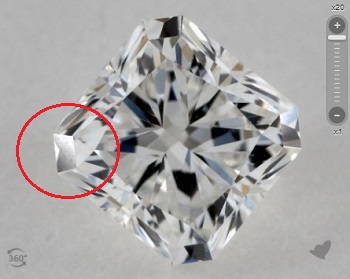
Chip – A small opening on the surface of a diamond often found near the edges or facet junctions. This inclusion is typically man-made and due to damage caused by accidental knocks or during the setting process.
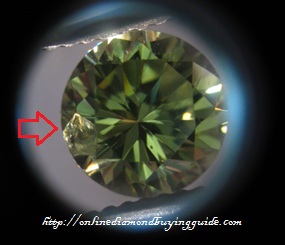
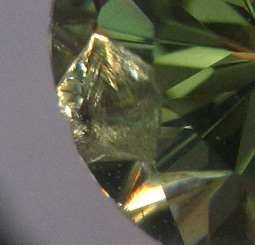
Indented Natural – A “flaw” which dips below the polished diamond’s surface. An indented natural is a part of the rough diamond that was left untouched during the polishing process and is usually found at the girdle.
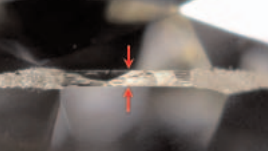
Indented natural indicated by red arrows. Source: GIA
So far, what I had shown you is a list of common inclusions that are found in diamonds. However, there are several clarity characteristics like etched channels or manufacturing remnants that are seldom seen and I have included the links here for the sake of completeness.
Moving on, did you know many shoppers actually make critical mistakes by selecting diamonds based solely on information from a grading report? The fact is, there are many hidden clarity related details that lab reports NEVER reveal to you.
On the next page, I’ll show you why this can be a costly mistake and how you can overcome the pitfalls of buying blind…
Related Articles

About The Website:

Leave A Comment
Latest Posts From Our Blog


Join Us On Social Media!



Visit The Gallery For Ideas!


32 Comments
I lost my engagement ring after 15 years. I’m looking for a replacement diamond. Can you provide an opinion about this one? The photo is the actual diamond. It had been pulled off the site for now so some additional photos can be sent to me. I was a little concerned with the comments about clouds that are not mapped out.
https://www.ritani.com/diamonds/round-diamond-1-10-Carat-H-color-GIA-certified/D-WY0VN2
Overall, I’m seeking a roughly 1 carat (or in that ballpark). H or higher round brilliant or cushion cut with 1.00-1.05 l/w ratio. Budget is around $3700-ish.
Thanks!
Please contact me via email directly as I would be able to address your concerns more appropriately.
What does inclusion mean? Do we say for the crack also inclusion? What does flawless mean?
In the context of diamond grading, the meaning of inclusion refers to internal features that are wholly or partially surrounded by the body of the diamond. Technically speaking, GIA doesn’t use “crack” when describing an inclusion as it is somewhat vague. For example, a cleavage, chip or feather could all describe a crack in the diamond depending on how you understand the term in English. That’s why GIA has standardized the naming of the different inclusions.
Flawless is a clarity rating simply means that there are no imperfections in the diamond at 10X (No blemishes and inclusions).
Hello Paul,
I have been shopping around for a 0.95 carat SI1 diamond for a while. My theories are,
1. for the diamond with features and without inclusion picture on the report, don’t buy because you don’t want to take a risk where is the feather.
2. I have seen a diamond with many twinning wisps received SI1 grade. If I ignore the twinning wisps on that diamond, I think it deserves VS1 grade. So out of all different kinds of inclusion, twinning wisps are the most forgivable.
3. only consider white inclusions in diamonds. Diamonds with black or colored inclusions are bad.
Please tell me what you think…
You are over complicating things and misguided in your beliefs.
Feathers usually aren’t an issue in small diamonds below 1 carat with SI1 grading. When diamonds undergo their polishing process, they are subjected to extreme conditions like high temperatures and force. Normal day to day conditions and activities are a far cry from that experienced during polishing.
Clarity ratings are assigned by GIA based on factors like durability and inclusion location. So, a diamond with twinning wisps isn’t necessarily better than one with a feather. It depends on a case to case basis.
A white color inclusion may also cause issues if it is large enough. Also, you need to pay attention to the comments section in the grading report if you are buying low clarity stones. If there are grade makers being described there then it may be a red flag.
Does GIA sort Clarity Characteristics based on how bad they are? If there is a dark black cloud inclusion in the diamond and another white inclusion of a pinpoint, would the black inclusion be sorted as the priority?
The most severe inclusions are always listed first in the grading report.
That’s to say, if you see something like this:
Crystal
Cloud
Pinpoint
The crystal inclusion would be the most significant and likely to be the grade maker of the clarity grade.
If you see something like this:
Knot
Cloud
Crystal
The knot inclusion is the most “severe” clarity characteristic in this case.
my colleagues and i have a misunderstanding on nature of a feather,i believe that the fact that its a ftr it will always go on the lower side of clarity when it comes to giving it clarity because it posses a durability issue,we had a feather on the table and we where caught between vs2 and si1,and based on the five factors number,relief,size,location and nature they gave nature vs2 because they say the feather is on the table not girdle but i belief nature has to be si1 because its a surface reaching inclusion not internal
It’s fine to have a discrepancy of one rating. Diamond grading is both a science and an art. When humans are involved, there is always some allowance to have some variances.
With a proposal in my very near future, the info on your website has been extremely helpful and informative.
Would you mind giving me your opinion of these three diamonds, please?
https://www.ritani.com/diamonds/oval-diamond-0-90-Carat-D-color-GIA-certified/D-JFJRNM
https://www.ritani.com/diamonds/oval-diamond-0-90-Carat-D-color-GIA-certified/D-JYHF11
https://www.jamesallen.com/loose-diamonds/oval-cut/0.92-carat-e-color-vvs1-clarity-sku-927965
Not great diamonds.
I would recommend these 2 stones instead:
https://www.jamesallen.com/loose-diamonds/oval-cut/1.01-carat-e-color-vs2-clarity-sku-885260
https://www.jamesallen.com/loose-diamonds/oval-cut/0.90-carat-d-color-vs2-clarity-sku-374111
Paul, I am in the market to buy a ~1.5 cw diamond. The cut I am looking for is Signature ideal, Color “G” and VVS1. I found the following diamond on Bluenile. Can you please let me know if it looks good to you for the price or would recommend anything else?
http://www.bluenile.com/diamond-details/LD07046282
Thanks for your help!
This BlueNile Signature stone looks like a decent choice. I’ve actually purchased a halo ring from BlueNile and chose their Astor diamond for the center stone. If you are interested, you can read about the experience and see the diamond ring in action here.
Hi,
I’m intrigued by this oval cut as it meets my desired specifications and budget; however, after viewing the GIA report I am concerned that the amount of clouding will impact the light transmission.
Based on the amount of clouds and their location, what are your thoughts on light performance?
http://www.bluenile.com/diamond-details/LD07155791
Read every single word in this article: https://beyond4cs.com/buying-diamonds-blind/
Hi Paul, can you please clarify that what is the worst defect inclusion in diamond which has the same clarity grade.
Let say between four of this; crystal, cloud, feather, needle.
Thanks and best rgds
Depends on clarity grades and case by case basis.
For example, a small feather is not necessarily better than a dark colored needle. A big feather near the edge of the girdle may cause durability issues while a feather found on the pavilion facets may pose fewer problems. Likewise, a cloud may be transparent and pose no effect on haziness while a dark colored crystal can look ugly.
Hi Paul,
Big fan – thanks for providing us with all this information, it’s making this process a lot less stressful.
After careful selection I blocked this stone for in-store review, and I’d love to hear your opinion about it:
https://www.ritani.com/diamonds/round-diamond-1-15-Carat-G-color-GIA-certified/D-Q2P2Q0
The HCA score is 0.7 and cut is the most important measure for me. I already requested ASET scans / videos / HD images, but I’d love to hear your input about it.
Thank you so much!
Hi Paul
I am looking to buy a 0.50cish diamond for $1,500-$2,500AUD inc taxes. Everything I have read has told me an excellent cut is a must have. Would the following stone be a good choice? I am concerned about the durability/eye cleanliness due to the placement of the feather:
https://www.jamesallen.com/loose-diamonds/round-cut/0.50-carat-f-color-si1-clarity-excellent-cut-sku-1979090
Appreciate your help!
The placement of the feather (at 4 o’clock) at the girdle area isn’t a concern. Generally, diamonds only have significant durability issues IF they are graded at I1 or lower at half carat size.
Hey Paul I’ve read numerous reviews that you’ve written. I’m trying to find a diamond on Ritani.. yes I read the review but i’m in Canada and it seems like a good place to start.
Please email me if you have time i have numerous questions i need help with. i could really use your expertise.
thanks
Hi Paul, Hoping to get some advice re buying online for a pear cut. How does this look? https://www.jamesallen.com/loose-diamonds/pear-shaped/0.90-carat-h-color-si2-clarity-sku-1165354 I’ve realised with my budget I probably need to compromise on colour and clarity and this is the lowest I’m willing to go. The exact same in store today was $4000…..I will need to factor in import tax etc because I’m in Australia.
The stone has good light performance and a lovely shape appeal. It’s a very good find. For an SI2 diamond, the inclusions are eyeclean.
Hey Paul, thank you for showing me what are the inclusions in diamonds formed naturally. Is there a ranking for clarity characteristics as to which are best and worst to have? What’s the difference between an indented natural vs chip?
No there isn’t any rankings. You shouldn’t be looking at clarity characteristics in this manner. Depending on the grade rating, different inclusions need to be examined on a case by case basis.
The definition of an indented natural is traces of the natural crystal that is left unpolished on the girdle of the stone. A chip is caused by damage due to an outside force or medium. They look different as well.
Hi Paul
Thanks for the info. I was wondering if there is any cause for concern with this diamond? There seems to be a big inclusion (feather/crack) in the middle?
https://www.bluenile.com/ca/build-your-own-ring/diamond-details/LD08248361
THanks for your help
The inclusion is a crystal and is actually very small. It can’t be seen with the naked eye and you are looking at it with a HIGHLY MAGNIFIED video. No worries there. It’s perfectly fine and OK.
https://beyond4cs.com/clarity/resize-technique/
I used a triplet loupe to inspect a loose diamond in the store. When look face up, there’s no cloud in the center just some white dots towards the edges. When tilted, I could see lots of white clouds almost every angle. I didn’t see much of these until I brought it home and inspect it under LED light.
The salesman claimed it’s vvs1 E color, 4.79mm stud earrings.
Can you please tell me what I should see when looking at 10X loupe. Shouldn’t it be free from clouds since it’s vvs1?
Any help would be appreciated. Thanks!
Who graded the diamond? Was it GIA or performed by someone inhouse? If it was the latter, you can be sure of a rip off. Also, just to be very clear, VVS1 clarity grades DO allow for cloud inclusions. If the diamond was indeed accurately graded, I doubt a layperson like you can find the cloud inclusions using a loupe. Even a trained professional like me would find it EXTREMELY hard to identify them under 10X.
Hi Paul,
I am about to purchase a diamond (put a deposit down to hold it). It is a 2.36 H VVS2 Ex Ex Ex none. It also has an HCA Score of 1.8. I have been looking for an engagement diamond for a long time, and this seems to check all of the boxes.
My only concern is that although it is a VVS2, the GIA Clarity Characteristics diagram has 5 decent sized clouds. All 5 are on the left diagram; 1 is on the table, with the rest on the crown (but near the table). There is a lot more drawn on the diagram than other VVS2s I have seen.
There is also the comment: “Additional clouds are not shown. Pinpoints are not shown”.
Is this something to be concerned about? If there are this many inclusions on the diagram, but it is graded a VVS2, does this mean that the clouds are very minimal (and I should pay attention to the clarity grade, not the diagram)?
Any input would be greatly appreciated!
Thanks,
Kevin
For a VVS2 diamond that is certified by GIA, please rest assured that cloud inclusions will not be an issue. When you describe the clouds as “decent size”, you’ve got to understand that this is a 2D plot diagram and the grader plots the topological view of the inclusions. It may or may not look worse than intended but the thing is, if it was bad, this would be a Si2 or I1.