Diamond Basics Archives
Carat Weight
Diamonds are always measured in carat weight. One carat is the equivalent of 1/5 of a gram. Additionally, there are "100" points in a carat, so that a .50 "point" diamond would be described as a half-carat.
In general, the pricing structure for polished diamonds is directly related to the pricing structure for the diamonds in their rough state. Because there is a scarcity of large diamond rough, the price for these diamonds after polishing will be higher per carat. As you get larger in carat weight there will be an incremental jump in price even between two diamonds of same color and clarity. These plateaus are found approximately every .10-.15 points. Category examples are: .50-.59, .60-.69, .80-.89, .90-.99 carat, etc

Clarity
Continued from previous post: Diamond Information
Clarity
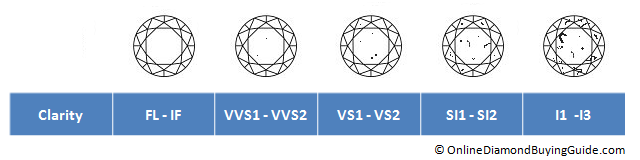
Almost every diamond will contain some blemishes, and inclusions formed during the course of its crystallization. The diamonds clarity grade refers to the visual impact of these characteristics or lack thereof, as viewed under 10X loupe magnification.There is a grading structure based on the GIA clarity grading scale used to describe inclusions within the diamond.
Color
Color
The "color" of a diamond refers to the presence or absence of inherent coloration in a white diamond. The whiter the diamond is the greater its value since a colorless diamond will allow increased light to pass through it and will consequently emit a greater amount of fire and brilliance. An appropriate analogy would be the difference between a clear glass window's superiority in allowing light to pass through it, versus a (color) stained glass window. Diamonds are graded for color against a white background so as to eliminate the possibility for any outside light to be absorbed by the diamond.
In the diamond industry we refer to the GIA color grading scale which begins with the letter "D" indicating the highest rating for a colorless diamond, and makes its way down the alphabet as it grades stones with hues of faint or significant yellowish and brownish coloration. The scale continues all the way to the letter Z.
Cut
Cut.
Where do we begin? Cut is the most misunderstood and underestimated "C" of the five "C's". Cut is properly referred to as the "make" or quality of the way the diamond has been crafted. "Cut", should never be confused with the "shape" of the diamond. The cut of the diamond is the only "C" that is entirely manipulated by the diamond cutter, and will determine the beauty and value of the diamond. A diamond can have perfect color and clarity but when poorly cut will yield very poor light return, and appear dull and lifeless to you. Conversely, a diamond that is cut to the highest standards and strictest adherence and precision to facet angle size, proportion, and location, will be your diamond that sizzles with superb brilliance, fire, and scintillation regardless of its color and clarity.
Diamond Cut
Diamond Cut:
Allow me to share a story with you;
A gentleman walks in to a local jewelry store looking to buy a diamond engagement ring for his fiancée. He sees a round wholesale diamond in the showcase that looks absolutely brilliant. The customer goes ahead and purchases the diamond assuming that it will look as stunning on his fiancée's finger as it did in the store. The poor guy gets home and excitedly opens up his package to take another look, and lo and behold; the diamond ring that looked so sparkly in the store now appears completely washed out and opaque. Not only is the diamond not brilliant and fiery but he can actually see what looks like "dirt" in the center of the stone that had definitely not been there in the diamond store.
He has no idea what happened to the diamond, but he knows that he cannot present this wedding ring to his fiancée. So he runs back to the store only to find out that this discounted diamond was part of a wholesale diamond section marked as "final sale" only.
He is now literally stuck with a diamond that is absolutely not what he thought he was getting when he paid for it.
Does this story sound familiar to you?
The question here is; why do so many loose diamonds and diamond jewelry items look absolutely brilliant inside the store, only to appear completely dull and lifeless outside the store?
The answer to this question is actually one of the oldest tricks being used in the diamond and jewelry industry. Diamond outlets and jewelry stores use high powered halogen lights that they strategically position inside the diamond showcases as well as over the countertops. These high intensity lights make all of the loose diamonds, diamond rings, and diamond jewelry look sparkly and brilliant. The unsuspecting customer will buy a loose diamond or diamond ring based on this effect, only to be severely disappointed when it is often too late.
This brings us to the following obvious questions:
* Why do many diamonds that are graded with an excellent color and clarity grade still appear completely dull and lifeless when looked at in real life lighting conditions?
* Why are there certain diamonds that display an incredible amount of brilliance and fire in ALL lighting conditions, from a jewelry store to a dimly lit restaurant or parking lot, regardless of their color and clarity grade?
* How can you as a consumer insure that you are buying a loose diamond or diamond ring that will absolutely explode with brilliance regardless of where you will take it?
The answer to these questions is the focus of this page.
The "Magic" of Cut
Only the cut of a diamond-its depth and width, as well as the size, shape, angle, and positioning of the diamond facets will determine its brilliance.
Of all the characteristics of a diamond that determine its value or rarity, "cut" is the one thing that is entirely manipulated by the diamond cutter and will make the difference between a visually brilliant diamond vs. a diamond with a dulled appearance and poor brilliance.
A diamond can have a perfect color and clarity grade but if it is poorly cut it will look like a piece of cut glass; dull and lifeless.
Conversely, if a loose diamond has been properly cut, it will achieve maximum brilliance regardless of its color and clarity, and will actually look more beautiful and brilliant than a poorly cut diamond of better color and clarity, for less money.
Here is how it works:
Light is constantly entering into the diamond through the table, which is the largest facet of a diamond or gemstone. Once inside, the light will travel within the stone by way of reflecting off of the round brilliant diamond's 58 facets which essentially act as a collection of mirrors. In a perfectly cut diamond the light will then refract and exit back out through the table to the eye in the form of brilliance. A perfectly cut loose diamond is therefore going to be the type of diamond that will display incredible brilliance in any lighting environment as it will essentially generate its own light.
In a diamond of poor cut quality the light will be misdirected when entering and exiting the stone. Instead of the light being refracted back through the table to the eye in the form of brilliance, it will be lost through the sides or escape from the bottom in the form of leakage. A poorly cut loose diamond is therefore going to be the type of diamond that will need to rely on the halogen bulbs of the jewelry stores to make it "appear" brilliant, but will be accurately exposed when removed from the lights as a result of its poor light refraction.
Ideal Cut Diamonds
Ideal Cut Diamonds
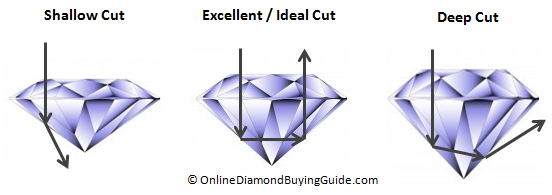
A diamond cut to certain angles and proportions will determine its beauty as well as value. Most of the diamonds being cut in the marketplace are cut to maximize on weight retention which results in the diamond being cut either too shallow or too deep. A shallow or deep cut diamond will result in significant light leakage.
Too shallow: Light escapes from the sides causing the diamond to lose brilliance. Too deep: Light escapes from the bottom causing the diamond to appear dull and lifeless.

An Ideal cut diamond is a diamond which is cut to a certain set of tolerances and parameters for all of its 58 facets which will result in maximum brilliance and light return. Think of it this way; a diamond is faceted as a collection of mirrors. When these facets are placed at certain angles in relation to each other they will allow light entering through the table to be evenly distributed throughout the entire diamond and then reflected back out through the table to your eye.
Why doesn't everyone cut diamonds to Ideal proportions?
1. The answer to this question lies in the fact that in order to create an ideal cut diamond, the diamond cutter will have to sacrifice rough carat weight in order to fashion a smaller, albeit more beautiful diamond. Cutting more diamond means cutting away more money, literally!
2. To create an ideal cut diamond a cutter must posses a superior level of ability and craftsmanship, and will need time and patience, as this requires considerably more time and effort than commercial quality diamonds.
As the diamond industry has evolved and diamond shoppers have become more savvy and educated, ideal cut diamonds and certainly super ideal cut diamonds have become tremendously popular for the discriminating consumer who insists on the very best cut quality diamonds, at discount diamond prices.
Hearts and Arrows Diamonds
Less than one percent of all diamonds being manufactured today can be considered a true Hearts and Arrows diamond.
The Hearts & Arrows pattern is found in a superideal cut diamond such as a SUPERBcert diamond. The Hearts and Arrows effect is achieved by cutting, aligning, and positioning, all of a diamonds 58 facets to perfection.
Hearts and Arrows Pattern
seen through a H & A viewer.
A true hearts and arrows diamond requires almost twice the amount of time to cut and polish as compared with a commercial quality round brilliant diamond.
Note the perfect alignment , shape, size, and meet point of both the Hearts and Arrows pattern.
Diamond Glossary
Diamond Glossary:
Knowledge is Power and the more information you have the better diamond purchase you will make. Here are a number of diamond terms that are used by jewelers to describe diamonds and which appear on diamond grading reports.
Blemish: A surface or inherent clarity characteristic of a diamond.
Brilliance: A phenomena unique and powerful in diamonds is the extent to which a diamond can reflect light. This "brilliance" is created when light enters through the diamonds table, reaches the pavilion facets, and is then refracted back out through the table to your eye.
Carat: A unit of weight by which a diamond is measured.
Clouds: A cluster of very tiny imperfections within a diamond. These imperfections will often take on a transparent cloudy look, and will require extremely high magnification in order to be seen.
Color grading: A grading method system by GIA used to determine the colorlessness of white diamonds.
Crown: The portion of the diamond above the girdle.
Crown angle: The angle where the diamond's bezel facets intersect with the girdle plane. The positioning of these facets is critical in determining the amount of light dispersion and fire in a diamond.
Culet: A flat facet diamond cutters add to the bottom of a diamond's pavilion. The purpose of the culet is to protect the integrity of the pavilion from chipping and fractures. Once a diamond is set in jewelry the purpose of the culet is generally negated as the setting will provide adequate protection for the stone. Most modern diamond shapes have either no culet, or very small pointed culet.
Cut: Refers to the proportions as well as the polish and finish of a faceted diamond. Cut is the most important of the "4 C's and is critically instrumental in determining a diamonds beauty and value.
Depth: The height of a diamond from the culet to the table. Depth is measured in millimeters.
Depth percentage: Refers to the relation between how deep and how wide the diamond is. Depth percentage plays a role in determining the brilliance and value of the diamond.
Diamond: A crystallized carbon made up of 99.95% pure carbon atoms in an isometric or cubic arrangement.
Diamond cutting: The method whereby a rough diamond mined from way beneath the earth's surface is polished and faceted into a magnificent diamond. The diamond must go through a long and arduous process of many different steps until it is considered a completely finished gem.
Dispersion: The effect that properly angled and placed facets have on the diamond's ability to display fire.
Eye clean: A term used in the industry to describe a diamond with inclusions that cannot be seen with the naked eye.
Facet: The various smooth surface areas of a diamond set up and positioned at different angles, allowing light to enter the stone and reflect back to your eye. A round brilliant diamond has a total of 58 facets.
Feathers: are the small stress fractures in a diamond formed during its crystallization process. Feathers will pose no risk to the durability of the diamond once that stone has survived the rigors of its crystallization, mining, and cutting process.
Finish: This refers to the quality of how the diamond cutter executed the designing, fashioning, and faceting of the diamond.
Fire: (or Color Light)This refers to the percentage of the diamond returning bright colored light to the observer.
Fluorescence: This refers to an effect seen in diamond when exposed to long wave ultra violet light. Fluorescence is undetectable in most lighting conditions and can only be seen when placed under an intense and direct ultra violet lamp. Fluorescence has no deleterious effect on the integrity of the diamond. Some prefer Fluorescence in diamonds, others do not. It is a matter of personal taste. Fluorescence in lower color diamonds posses a unique desirability as they will make diamonds appear whiter than their actual color grade.
GIA (Gemological Institute of America): Was founded in 1931 as a non profit organization and is considered to be the standard bearer of the diamond grading industry with the strictest, most stringent diamond grading criterion. The grading system developed by the GIA has become the standard system used today by grading labs across the world.
Girdle: The outer ring of the diamond is called the girdle. The girdle is described by its thinnest and thickest points.
Inclusion: An intrinsic clarity characteristic found within diamonds.
Naturals: Small particles of the original rough diamond's surface which remain on the polished diamond.
Pavillion: This refers to the lower portion of the diamond underneath the girdle.
Point: Refers to a measurement describing the weight of a diamond. One point equals one hundredth of a carat.
Polish: This refers to a diamond's surface blemishes which do not affect its clarity grade such as polishing lines or scratches. Polish is graded on laboratory reports as either ideal (AGS) excellent, very good, good, fair, or poor (GIA).
Scintillation: This is the term for changing colours, the radiance and sparkle of the rays when the stone is moved or when the light source changes. The GemEx Brilliancescope ™ analyzer that we use for all of our diamonds measures the number of light points and determines how they change from position to position.
Symmetry: Variations in a diamond's symmetry such as misshapen or misaligned facets are graded in the laboratory report. Although such variations are often undetectable to the naked eye, it is certainly indicative of a diamonds cut quality.
Table: percentage Represents the diameter of the table facet in relation to the diameter of the entire diamond.
Diamond Cleaning
Diamond Cleaning and Care
It is extremely important to clean and care for your diamond by periodically soaking it in a solution of warm water and liquid soap, or a jewelry cleaning solution. A simple brush (toothbrush, etc.) may be used to dislodge built up dirt from the surface of the diamond. Always, make sure to rinse off the diamond and dirt with a non abrasive cloth. A diamond when properly cleaned will allow maximum light to reflect back to your eye. Conversely, when a diamond is smudged, oily, and dirty it will appear dull and lifeless.
I don't recommend the usage of ultra-sonic cleaning devices on a mounted diamond as these machines are apt to loosen the diamond from its mounting with its powerful vibrations.
Have your diamond ring checked by a competent jeweler every 6 months.
The proper care of of your diamond will assure you of a lifetime of enjoyment and happiness.
Diamond Grading Report: Why you need it and what it is telling you.
A Diamond Grading Report issued by an Independent Gemological Laboratory, tells you that the Diamond has been examined by experienced Diamond Graders, using various gemological instruments, and contains the characteristics as stated in the Certificate.
The reason it is important to have a Diamond evaluated by an independent Laboratory is that minute, invisible to the naked-eye, characteristics of a Diamond can have a major influence on the price. Therefore, if not for a great deal of scrutiny on the part of the buyer, it is easy to mistake and purchase a Diamond of lower value, believing it to be of higher value.
I strongly recommend that you do not buy any diamond without a Diamond Certificate. GIA is the foremost Laboratory in the world, though there are other reputable labs out there. However, not all labs are equal in their grading stringency, accuracy, and consistency.
If you found a Diamond you like, and it is not certified there is nothing wrong with asking your Jeweler to send it to a reputable independent Gemological Laboratory for certification. If your Jeweler has a problem with that, take a few steps back and ask yourself many more questions! This request is a standard practice in the Diamond Industry.
What's in a Diamond Lab name?
The number one most important item to look for on a Diamond Certificate is the name of the laboratory! If you never heard of the Laboratory, don't feel shy about giving them a call to check them out. Also, if the laboratory is an independently owned franchise and the certificate you were given is not local, you may want to call up the lab, either the local one or the one that issued the certificate, and ask them by which standards they grade their Diamonds. Find out if they honour the grades given out by other branches.
GIA is the foremost grading laboratory in the world both for their excellence in diamond and gemstone grading as well as for their comprehensive research and educational programs to both the trade and consumers.

Actual GIA Grading Report:

Basic Parts of a Round Brilliant Diamond.
Let's go over this report and examine the information it gives you:
Every lab has a certificate (or " report") number, which uniquely identifies a Diamond. The Lab keeps an internal copy of everything which you see on the certificate, plus some additional information for their files. If you call up the Lab and give them the certificate number, they can even reissue a certificate if you lost it. This report number is found in the upper left-hand margin and appears vertically. The Cert number for the GIA report shown here is: 11510402.
Diamond Shape: Self explanatory.
Measurements: Measurements of the Diamond's diameter:
"minimum - maximum x depth" are calculated to the hundredth of a millimeter by a Leveridge Guage or a micrometer.
Weight: Diamonds are weighed to the thousandth of a carat with a digital measuring device. On the certificate, weight is rounded to the hundredth of a carat. Diamonds are always measured in carat weight. One carat is the equivalent of 1/5 of a gram. Additionally, there are "100" points in a carat, so that a .50 "point" diamond would be described as a half-carat.
In general, the pricing structure for polished diamonds is directly related to the pricing structure for the diamonds in their rough state. Because there is a scarcity of large diamond rough, the price for these diamonds after polishing will be higher per carat. As you get larger in carat weight there will be an incremental jump in price even between two diamonds of same color and clarity. These plateaus are found approximately every .10-.15 points. Category examples are: .50-.59, .60-.69, .80-.89, .90-.99 carat, etc.
Proportions: Depth Percentage and Table Percentage are measured.
Depth percent refers to the percent of the depth of the Diamond, table to culet, relative to the width of the stone.
The Table of a Diamond refers to its largest facet, the main part of the Diamond you look at when the stone is face-up.
Table percent refers to the table size as a percentage of the Diamond's average width.
These ratios in conjunction with the Millimeter measurements indicate how "well" the Diamond has been cut.
Girdle: The Girdle of a Diamond is the dividing line between the crown, or top part of the stone and the pavillion, or bottom part of the stone. Girdle thickness can be very thin in part of a stone and very thick in another part. That is why it is expressed as a range. The girdle can also be faceted, or not. A faceted girdle usually improves the look of the stone, and involves having the cutter polish facets into the girdle.
Culet: If there is one, is the facet on the pointy bottom part of the Diamond. Its existence helps prevent chipping.
Finish of the Diamond, referred to as Polish and Symmetry:
Finish describes the polish of a Diamond and how symmetrical, or how evenly, the facets have been placed.
Polish refers to the quality of the polish on the facets. An excellent polish reflects the care taken by the Diamond cutter.
Symmetry refers to how precisely the facets are externally aligned to each other. All the facets should have more or less the same shape and size.
Clarity Grade:
Clarity ranges from the best grade of IF, down through VVS1, VVS2, VS1, VS2, SI1, SI2, I1, I2 until I3. Clarity is a reflection of the number, size, placement and nature of inclusions and/or surface irregularities on the Diamond. The experienced Diamond Grader examines the Diamond with the aid of a Stereo Microscope, which aids in identifying the nature of an inclusion, or finding pinpoints (very, very tiny crystals inside the Diamond). However, the actual grade is based only on what is visible under a 10X Loupe.
Color:
Color ranges from the best grade of D, down to Z. After Z are Fancy Colors. Color grade is determined by examining the Diamond next to a master set of color comparison stones, under special lighting.

Fluorescence:
Fluorescence refers to a Diamond's reaction to long wave ultraviolet radiation. Fluorescence or blue diamonds is a hotly debated topic with much erroneous information being disseminated to consumers.
Read this link on our Blog for more detailed and accurate information on blue diamonds. Blue Diamonds
The Diamond Plot:
The Diamond Plot is a graphical representation of the imperfections of the Diamond. Each Diamond is as unique as a fingerprint. By plotting its characteristics, and combining this with the physical measurements of a Diamond, a Lab can uniquely identify each stone. This plot helps the Grader in the even that a customer returns to the Lab and requests a verification that the Diamond presented with a certificate refers to the same Diamond described in the Certificate.
Internal characteristics are plotted in red, and external characteristics are plotted in green.
Comments:
Comments are used to describe characteristics not discussed elsewhere on the certificate, or to mention items not plotted. For example, "minor details of polish are not shown" is a common comment. "Crown angles over 35 degrees", or Crown angles under 30 degrees" are other comments pertaining to Cut that may also appear.
Diamond Cut: How do you know if your Diamond is a Good Cut?
In an earlier post located here, Diamond Grading Report
the importance of purchasing your diamond that is accompanied by a grading report done by a reputable and highly competent lab such as the GIA (Gemological Institute of America) was stressed and highlighted. This report assures you that the Color and Clarity grades and measurements are accurate. But this level of information is not enough to tell you if the diamond you're interested in has been properly proportioned so that it is not too spread and shallow nor narrow and deep in relation to it's carat weight. A diamond in the first case is referred to as a "fish-eye" and in the second case a "nailhead."

Above: Two examples of poorly proportioned diamonds that have been "swindled" (diamond-cutter term) for maximum weight retention at the expense of correct proportion. Result: You are paying more for "less". Note the difference between the ideal proportioned diamond versus the shallow and deep stones.
In both instances the diamond will display significant amounts of light leakage, look glassy, and be visualy unattractive.
There are two machines on the market today that do a very good job of measuring a diamond's proportions and providing you with critical information on a Diamond's Cut. They are the OGI Scope manufactured by OGI Ltd. and the Sarin machine, manufactured by Sarin Technologies.
Let's take a look at the OGI machine.
OGI Diamond Proportion Scope.
The diamond is centered on the pedestal, lid closed, and software activated. The pedestal rotates for approximately 45 seconds allowing the internal camera to map the proportions of the diamond.
The MegaScope accurately and reliably measures the cut of your loose diamonds. Basic measurement accuracy is: 0.02 mm. Keep in mind that there may very well be a slight but statistically insignificant difference between the Megascope measurement of Table and Depth percentage compared to that of the GIA report. This is because:
1. There is a very slight variability inherent in the Megascope itself,
2. Pedestal Placement varies ever so slightly from one run to the next, and
3. GIA graders take the average of four measurements and round off to the next highest number.
Overall, both the GIA and the Megascope and Sarin proportion analyzers are in agreement.

Megascope Diamond Proportion Analyzer.
The properties analyzed in loose diamonds are Weight, Diameter, Crown Angle and Height, Pavilion Angle and Depth, Culet Size, Culet Off Center, Table Size, Table Off Center, Total Depth, and Girdle Thickness.

Above:Parts of the Diamond that are measured by the Megascope.
An additional feature is the Top/Down Report, which shows you the cutting angle and percentage for each of the 8 Crown and 8 Pavilion facets. This information affords you more specificity than just the "averages", by providing detailed information regarding the cut precision and tolerances of the diamond.
Additionally, the MegaScope is set according to the American Gem Society (AGS) scale for what would qualify as an AGS scale from 0-4 level cut diamond. This Cut Grade is inversely proportional to the level of Cut excellence with 0 being the best.

Above: Detailed Megascope Report. First Report at the top of the page are the averaged numbers for the Table, 8 Crown, 8 Pavillion facets, the girdle facet and the culet facet.
Bottom: Detailed analytical report which displays level of cut precision of each of the upper 8 Crown and lower 8 Pavillion facets.
The less variance in cut angle between facets, the greater is the cut precision of the stone and greater probability that the diamond will refract maximum light to your eye. Note that the above diamond shows incredible Cut precision with variance between upper and lower facet angles of less than one degree ( Facet angles are indicated in Red, facet slope percentages in Blue)
Ask your jeweler to provide you with either a Megascope or Sarin Proportion Analysis of any diamond you are considering for purchase.
Knowledge is the power to make an informed decision and get value for your hard-earned money. You wouldn't buy a house without a comprehensive and detailed engineer's report. A diamond should be no different. A reputable jeweler will want to make sure you are fully informed.
Diamond Shopping on the Internet: Does Your Diamond Sparkle and Light Up?
A major question being asked by consumers shopping for diamonds on the Internet is how can I tell if the diamond I'm interested in sparkles and is brilliant? Most diamond websites show only the data from the Lab report, others only sample or generic images and the few sites that do display actual photo's are of undefined lighting conditions and of poor resolution.
Gemex Systems of Mequon, Wisconsin (www.gemex.com) has developed a spectrophotometer called the Brilliancescope that measures a diamond's light performance.

Above: Brilliancescope by Gemex Systems.
A diamond is scanned in the Brilliancescope by having a light reflected back through the diamond's crown at six different angles from the light source. Light performance is measured and compared against a database of thousands of diamonds and categorized as White Light (Brilliance), Colored Light, (Dispersion), and Scintillation (Sparklies). The results are presented in two ways: As a linear graph that shows how a diamond performs against the entire database and as six digital photographs; 5 reflective and 1 diffuse which depicts the Cut Symmetry of the diamond. The photographs display amount of light intensity, location and distribution of light, and extent of interaction between the light components being measured by the machine.

Above: Brilliancescope Light Analyses Report. Note the light intensity, location and distribution of reflected light as depicted in the 5 Light Views and the symmetry in View 6.

Compare to the Brilliancescope above. Note the significant differences in light intensity, distribution, and interactions.
Buying a Diamond: Some Basics.
There is so much information available today on diamonds that you really owe it to yourself to educate yourself properly prior to taking the plunge for your dream diamond.
Reading books and browsing excellent diamond information websites on the internet is certainly a great place to start. However, you still need to learn the basics on the diamond buying process so that you can prepare yourself for what lies ahead. Remember that you are about to embark on an emotional, once in a lifetime (you hope..) purchase for a significant dollar value. Just like you would not buy a car or a home without doing proper homework; similarly, you will need to arm youself with knowledge before you can be certain that you are buying a quality diamond.
Here are some of the diamond basics:
First learn about the Four "C'S" of diamonds and how they affect a diamonds rarity, beauty, and price. Most importantly, unless you are ready to blow thousands of dollars on a diamond that will look like frozen spit, make sure that you absolutely "know your stuff" when it comes to "Diamond Cut" specifically. The degree of precision to which your diamond has been Cut is most crucial in determining how brilliant your diamond will appear to the eye.
The fact that most people want a BIG diamond is fine, just be aware that often times there is a direct consequence to getting a diamond that was crafted to achieve a big carat weight. By cutting a rough diamond for maximum weight retention, the diamond cutter will sacrifice on the beauty and brilliancy of the stone. Conversely, by sacrificing carat weight and cutting away more diamond from the rough, a cutter will achieve a smaller diamond of infinitely greater brilliance, fire, and scintillation.

Above: Three diamonds of the same carat weight cut to different proportions. Buying the shallow or deep cut will give you less diamond for more money. A poorly proportioned diamond will have less Brilliance, Dispersion, and Scintillation.
I recommend that you see for yourself the difference between a (larger) diamond of poor cut quality versus a (smaller) diamond of ideal cut proportions. The physical, visual difference between the two diamonds is absolutely profound and will certainly be food for thought.
Go to your local jewelry stores and see what kind of quality diamonds they are offering you and what their prices are. Remember to take the diamonds as far away from the countertop as possible. The diamond and jewelry stores all use high intensity halogen bulbs in their showcases that makes all of their diamonds and jewelry look fabulous. This is one of the oldest tricks in the book, so make sure that you give yourself a chance to see how the diamond will actually look in real life lighting conditions....you may be very surprised.
Ask for an INDEPENDENT diamond certificate. This is a diamond grading report issued by a diamond grading laboratory whose only interest is to give you a proper evaluation of the diamonds characteristics. The most recognized diamond laboratories in the world are the GIA and the AGS. There are other laboratories out there including some "labs" that are used by some jewelry stores whom nobody ever heard of. These labs that have a vested interest in protecting the proprieter, are known to give diamonds better color and clarity grades than they actually deserve, are essentially worthless and quite harmful to you. Make sure that you don't wind up with a diamond graded by one of these "laboratories" of dubious distinction; you'll be paying for something that you are not getting.
Diamond Color Grading Starts with the Letter "D": Why?
The color grading for colorless to near colorless scale is denoted in letter grades that run from "D" to "Z". Most diamonds used in jewelry are nearly colorless with faint yellow or brown tints. These diamonds fall in the normal color range. A diamond that is said to have 'fine color' has little or no visible coloration. The less color, the higher the value.
The GIA (Gemological Institute of America) instituted the "D-Z" scale back in 1953. Until that point, there were various poorly defined color grading scales that were confusing to consumers.
Color systems that were used ranged from numbers (0,1,2,3) to Roman Numerals (I, II, III). Letter grades were also used, e.g.; A, B, C, and even "AA". Descriptive terms such as "blue-white" and "gem-blue" were also used. All of these grades had shifting definitions and variances depending on the dealer being shopped.
GIA decided to make a fresh start and introduce a color-grading scale that would have absolutely no connection to any of the previous scales. Thus the GIA scale starts at the letter D.
Today, this GIA color grading scale has universal acceptance and is used by all grading laboratories and tradespeople.


Above: GIA Color Grading Scale.
"Extremely Thin" Girdles In Princess Cuts: Cause for Concern?
Current conventional wisdom and advice to consumers is to stay away from diamonds that display 'extremely thin' (ET) girdles. The rationale is that such girdles may be more susceptible to chipping or breaking compared to girdles that are classified as 'slightly thin' and greater.
In our opinion, this needs to be placed in proper context. ET girdles need to be seen and evaluated within the total view of the diamond's entire girdle. In many cases an ET still will have enough bandwidth so as to not pose any danger to the diamonds structure or foundation. Furthermore a designation of ET may only refer to one or two spots along the girdle's continuum and such designation applied only in reference to the girdle width of the rest of the diamond.
Attached is an example of a Princess Cut that GIA has evaluated as having an ET girdle. Note that this girdle side still has sufficient "meat" on it so that it poses no danger to the stone; but in relation to the adjacent very thick girdle it can be classified as an ET girdle.

Our advice is to work with vendors that either have the diamond in stock or can call it in for a personal evaluation.
Sarin Company Incorporating GIA's New Diamond Cut Grade System.
Israel’s Sarin Technologies will incorporate a new GIA cut grading system in its DiaVision product for grading and re-cutting polished diamonds and in Advisor, the company's rough diamond planning software.

Sarin Diamension machine measures Cut parameters of your Diamond.
A release issued on May 16 said that these new programs will work on most of Sarin’s existing machines, allowing them to continue to increase their productivity with only a software upgrade.
The new GIA cut grading system is the result of research on the way light behaves within diamonds and the relation between diamond proportions and its appearance. One of the conclusions of this research, implemented in the new grading system, is that diamonds of different appearance may still yield a top cut grade, allowing for higher potential rough yield for manufacturers, while providing the necessary flexibility to diamond traders and retailers who need to accommodate changing market needs.
Sarin Technologies is scheduled to present an advanced peek of the new GIA grading system in its products at the upcoming JCK Las Vegas Show,
June 2-9.
Buying Your Diamond: Rely on the "Numbers" or Light Performance?
We are constantly asked by Consumers to evaluate diamonds for them solely based on the "numbers" provided by the Laboratory certificate and the Cert's designation of the diamonds Polish and Symmetry. In our opinion, assessment of the "numbers" are important in describing external symmetry but can be limiting in that they do not tell you anything about the diamonds optical symmetry and Light Performance.
Light Performance is what you're buying and what you and everyone will notice.
We have published a tutorial on the importance of using Diamond Light Performance as a tool to base your purchase decisions.
Read it Here: Diamond Light Performance
We were asked yesterday whether in round shape diamonds a Symmetry designation of "Very Good" on a GIA Report is a negative and drop-off compared to a symmetry designation of "Excellent".
The answer is that Symmetry as shown on the GIA Cert refers to external meet-point symmetry, not optical symmetry or Light Performance.
The red arrows in the attached graphic show you the meet-points that are examined by GIA graders.

Red Arrows show the "Meet-Points" that determine the level of Symmetry.
To receive "Excellent" they must meet exactly and the meet-points of the Table - to - Crown - to - Pavillion must align exactly to each of the arrowed points. The difference between "Excellent" to "Very Good is indeed miniscule and microscopic and is something that no one will see or realize.
This external meet-point symmetry has absolutely no bearing on the diamonds light performance, which is what ultimately you are buying. No one will 'see' if the symmetry is "Excellent" or "Very Good" but you, and they, will definitely notice whether or not the diamond sparkles with light.
I've included two graphics showing Ideal Cut diamonds; one that we called in for a client and the other (our own SuperbCert H&A Diamond with Very Good Symmetry). Compare the light performance as measured by the Brilliancescope(www.gemex.com)of the diamond with "Excellent" symmetry to the light performance of the diamond with 'only' Very Good Symmetry. There are visibly dramatic and significant differences in Light Performance.

Ideal-Cut Diamond with "Excellent" Symmetry but poor-mediocre Light Performance as measured by Gemex's Brilliancescope Light Performance Analyzer.

Ideal-Cut Diamond with only "Very-Good" Symmetry but Superb Light Performance.
There are over 750,000 diamonds in the Gemex Database that have been scanned and evaluated for Light Performance. We have been using this technology for the past four years and find it an important tool for evaluating diamonds.
SI-3 Clarity Grade: Legit or Gimmick?
With diamond prices consistently going up we have received inquiries regarding the "SI-3" clarity grade. This clarity grade was introduced and offered by several grading labs beginning in 1992 at the behest of manufacturers seeking to squeeze more dollars out of consumers.
In our opinion and in the opinion of many in the trade, the SI-3 grade is a bulls--t grade that is removing the stigma of and really elevating an I-1. It's twilight zone diamond grading or like saying she's "a little bit pregnant."
Clarity grading of inclusions is predicated on three factors: 1. Location, location, location, 2. Size, and 3. Color. Inclusion(s) towards or in the center of the stone that are black, large and perhaps visible without magnification will logically receive a lower clarity grade than smaller, white, and/or wispy inclusions towards the periphery. Clarity grading does carry some subjectivity, but it is highly instructive that the #1 grading lab, GIA, does not acknowledge or use the SI-3 clarity grade.
Your ability to see inclusions in the face-up position without a loupe is critically dependent on the Cut of the diamond. The better the Cut, the more light coming up and out throught the top of the diamond, and the less likely you will pick up the inclusion(s). This goes for every diamond shape with the possible exception of the Emerald Cut, in which VS-2's may be noticeable due to it's unique facet geometry.
Improving the Cut of a diamond may therefore make an I-1 / I-2 clarity grade a viable candidate for purchase. Use your eyes and work with reputable vendors that know their diamonds.
Tutorial on Loose Diamond Shapes

When choosing a diamond ring for that special woman in your life, one of the most important choices you will have to make is the shape of the diamond itself. Every diamond shape has its own unique look and should therefore be carefully considered before making a purchase. Many women focus on choosing a diamond ring that flatters the shape and length of their fingers.
We have put together some information on the most popular diamond shapes in the marketplace today.
Round Brilliant Cut Diamond
The round diamond is the most traditional and popular of all diamond shapes. Approximately 80% of all loose diamonds being sold in the marketplace are round cut diamonds. A round cut diamond has a total of 58 facets, 33 on the top portion called the crown and 25 facets on the bottom called the pavilion. A round diamond that is cut to ideal cut diamond parameters will be the most beautiful and brilliant of all the diamond shapes. It is for this reason that round diamonds are most often set in solitaire, four-prong engagement ring settings to showcase their brilliance.
The round cut diamond has evolved tremendously over the years and has rightfully earned its place today as the most desired and sought after of all of the diamond cuts. At exceldiamonds, we offer the pinnacle in round diamond perfection with our featured SuperbCert Hearts and Arrows Diamonds. We also carry an amazing expert selection of the finest round ideal cut diamonds available today at discount diamond prices.
Princess Cut Diamonds
The princess cut diamond is the second most popular diamond shape after the round diamond. Traditionally, the princess cut diamond has been a diamond shape that does not allow for maximum beauty and brilliance. This is partially due to its four corners which will allow too much light to leak out of the diamond instead of being directed back to the eye in the form of brilliance. Many diamond companies and manufacturers have attempted to combat this by creating modified square diamonds with tapered edges. The problem with this approach is the fact that it destroys the beauty and elegance that has always been associated with a true square diamond. It is for this reason that we decided to create the perfect princess cut diamond, focusing on maximizing the diamonds brilliance without deviating from the traditional square diamond shape. We have accomplished this with our SuperbCert Signature Princess Cut Diamonds. Read about it here.
Oval Cut Diamond
The oval cut diamond is actually an elongated brilliant cut diamond and is traditionally set with two smaller diamonds flanking the center diamond on either side. Although the oval diamond is not as popular as a stand alone diamond in a solitaire engagement ring, it is very sought after in a three-stone diamond engagement ring. When the oval diamond is cut well, it has tremendous brilliance and fire.
Because of its elongated shape and curvature, it is considered a very classical and elegant diamond. The type of setting you choose for your oval-shaped diamond will greatly impact the impression it gives. Choosing a pave diamond ring for your oval diamond, or smaller flanking diamonds will greatly enhance the overall look.
The oval diamond ring is a timeless engagement ring that flatters the shape of the hand and will always remain in style.
Marquise Cut Diamond
Of all the fancy diamond shapes, the marquise diamond is the diamond of choice for royalty and is quite possibly the most regal and elegant of them all. The diamonds elongated shape makes the fingers appear longer. The unique structure of the marquise diamond makes it approximately twice as long as it is wide, with beautiful tapered points on each end. The shape and structure of the diamond will make it appear larger than what it actually weighs in carats. This is due to the large surface area of the stone. Therefore, you can actually a purchase a smaller marquise diamond engagement ring than you would in a different diamond shape, and have it appear significantly larger to the eye.
An important consideration with a marquise diamond is the length to width ratio of the stone. This will determine how brilliant and sparkly the diamond will appear to your eye. If a marquise cut diamond is cut properly, it will have excellent brilliance. Otherwise, it will exhibit a “bow-tie” effect in the center of the stone where you will see a dark black (bow-tie) area with an obvious lack of brilliance.
The ideal length to width ratio for a marquise diamond is considered to be 1.8: - 1 or 2:1
Emerald Cut Diamond
The emerald cut diamond, (cut similar to a precious emerald gemstone) also known as a step cut diamond (for the way it resembles a set of steps) has fewer facets than the more popular round diamond. The diamond is rectangular or square in shape with tapered corners. While the round diamond has 58 facets, the emerald cut has only 25. Because the light entering into the diamond has fewer surfaces to reflect off of, there is noticeably less fire in emerald cut diamonds. As a direct consequence, inclusions within the emerald diamond as well as lower color grades will be much more visible to the naked eye. It is therefore important to consider a higher color and clarity grade when purchasing an emerald cut diamond.
By now you must be asking yourself; why should I even consider an emerald diamond engagement ring?
Well, the truth is that the emerald diamond while not as fiery as other diamonds is exceptionally sophisticated and very sought after. Unlike many other fancy shaped diamonds which look somewhat similar, the emerald diamond has a completely unique look of its own.
Women who prefer the emerald diamond are not really looking for a diamond that will blow people away with maximum brilliance and fire. Rather, they are looking to make a clear statement about their creativity and individuality. In this capacity the sleek and beautiful look of this popular heirloom diamond cannot be duplicated.
The emerald cut diamond ring today has become increasingly popular with celebrities and the fashion elite.
Asscher Cut Diamond
The Asscher cut diamond is a kind of derivative of the emerald cut diamond in a square shape with a total depth that is typically greater than the modern emerald cut diamond. The diamond is named for Joseph Asscher, founder of the Royal Asscher Company, established in Amsterdam in 1854. A master diamond cutter of world repute, Joseph created his Asscher cut in 1902. His unique diamond cut became an instant sensation and was incredibly popular for many years. Even though it is very rare to find an original Asscher cut diamond today, some were passed down from generation to generation and are purchased as jewelry estate pieces.
Asscher is also known the world over for being the cutter of the world’s largest (known) diamond; the 3,205 carat Cullinan Diamond. Asscher was commissioned by British King Edward VII with the cutting and faceting of this monster diamond. The project took him approximately 6 months where he did nothing but study and analyze the diamond rough to determine how best to cut the stone. Ultimately, Asscher created 3 individual and perfectly flawless diamonds from the rough; all of them famous.
The revival of this kind of art deco style diamond jewelry has been the catalyst to bring the Asscher cut diamond back to the forefront of today’s diamond buying public.
A unique aspect of the Asscher diamond is that there are no set proportions or “numbers” with which to cut the diamond. Sure, the diamond does have a basic square outline and step facets, but that is it. The diamond cutter will craft each Asscher diamond with intent on maximizing light performance and beauty. The result is a diamond of incredible beauty and timeless appeal.
Heart Shape Diamond
One of the most delightful of all diamond shapes, the heart shape diamond hides its true complexity behind a veneer of romance. Heart shaped diamonds are actually pear shaped diamonds with a distinctive cleft on top instead of the rounded edges.
It is incredibly difficult to cut a piece of diamond rough into a beautiful (polished) heart shape diamond. It requires a great degree of skill and even one mistake on the part of the diamond cutter will make the difference between a visually stunning vs. a lifeless diamond.
Like pear shaped diamonds, the specific length or width of the heart diamond can change. However, in order for a heart shaped diamond ring to be valuable, it must exhibit proper symmetry. This means that the diameter across its widest perimeter (known as the "shoulders" of the heart) should be equal to its length. The way to measure length is by running a vertical line from the cleft to the tip of the diamond.
The interesting thing about the heart shaped diamond is that just like it promotes the notion of individual romance, it is also gauged for beauty and brilliance in a much more personal and subjective way.
Pear Shape Diamonds
“Teardrop of the Gods”, the pear shape diamond is considered an exquisite diamond for use in quality jewelry and designer engagement rings. The pear shape diamond is exceptionally beautiful and elegant and can be set in a solitaire engagement ring or even a diamond ring with side stones.
The pear shaped diamond is essentially a fusion of the marquise and oval diamonds, combining the “best of both worlds”. You get the beautiful rounded edge on top of the diamond, as well as the distinctive taper on the bottom. A pear shape diamond engagement ring is an assertion of impeccable taste and refinement.
Radiant Cut Diamonds
A cross between a round cut and emerald cut diamond, the radiant cut diamond can be quite beautiful and brilliant. The radiant diamond is typically comprised of 70 facets and is either square or rectangular in shape. Although its popularity has somewhat faded over time, finely cut radiant diamond engagement rings have recently become popular again.
Cushion Cut Diamonds
Cushion cut diamonds gets its moniker from the aesthetic appearance of the stone. The cushion diamond is often crafted for maximum weight retention and is considered an excellent choice when set in a micro pave diamond or halo diamond engagement ring setting. Because the cushion diamond usually appears larger than its actual weight, it is an ideal diamond choice for many who would like the look of a larger diamond at a better diamond value.
Cushion cut diamonds are extremely beautiful when used and incorporated in lavish diamond engagement rings, like antique or vintage diamond wedding rings. Designer jewelry companies will often showcase their dazzling and expensive diamond jewelry set with cushion cut diamond of all sizes.
The cushion cut diamond has garnered a tremendous fan club for its classy look and beauty in jewelry pieces and is considered to be one of today’s “hot diamonds”.
The Art of Diamond Cutting.
Diamond Cutting-Overview

The most important aspect of a polished diamond is the quality of the diamond “cut”. The cut of a diamond is the one thing which is entirely manipulated by the diamond cutter and will determine the visual beauty of the diamond. A well cut diamond will have tremendous brilliance regardless of its color and clarity grades. Conversely, a poorly cut stone will appear dull and lifeless even if it has a top diamond color and diamond clarity grade.
For all diamond shapes, the diamond cutter has two objectives which will often conflict: to save the greatest possible amount of the weight of the rough diamond (so as to allow for a larger and more expensive polished diamond) and to create a diamond which is brilliant and valued in the marketplace.
Poorly proportioned stones retain more weight while the best proportions will demand greater loss of weight. Therefore, faceting a diamond for maximum weight retention means that the diamond cutter will sacrifice less of the diamond rough but will end up with a diamond of poor brilliance and significant light leakage. Faceting a diamond for maximum brilliance means that the diamond cutter will sacrifice more carat weight in the rough in order to create a visually stunning polished diamond. Our SuperbCert Signature Super-Ideal Cut Diamonds as well as our expert selection of Ideal Cut Hearts and Arrows Diamonds have all been crafted to achieve maximum beauty and brilliance, with no regard whatsoever for weight retention.
Cutting Process
The stunning ideal cut diamond your wife has in her engagement ring looks very different from what it looked like when it was originally mined from way beneath the earth's surface!

There are a few basic steps that are required in order to transform a piece of diamond rough into a 58 faceted (polished) round brilliant diamond. These steps require a tremendous amount of skill and patience on the part of the diamond cutter. Many difficult calculations and decisions must be made by the cutter before the work begins.
Planning/Marking

The initial step is to choose the shape and size of the final diamond (s) which will be created from a particular piece of diamond rough. This can be a very complicated decision, since it can involve tradeoffs to avoid inclusions which will make the diamond (s) smaller but less included and possibly more valuable. Once a decision is made the diamond rough is marked accordingly.
Cleaving/Sawing

Diamonds can be cleaved or sawn. The expert must decide which option to choose. Cleaving the diamond only takes a few seconds. It involves a chisel and hammer and it must be done with the grain of the diamond otherwise the stone will break in a way that will ruin it.
Most diamonds are sawn. The sawing process involves a special blade coated with diamond dust which spins at high speed to gradually cut through the stone. There is also a relatively new laser technology that is used to saw rough diamonds. Once this part has been done, the diamond is sent back for checking and then passed to the next phase called bruting.
Bruting

Bruting is the process of giving the rough diamond its basic round shape. During the bruting stage, one diamond is forced against another on a special rotating wheel. This is the only way to actually form the shape of the diamond; by having it manipulated by a second diamond.
Polishing/Faceting

Polishing is the very last step of the diamond cutting process. In this phase, the final proportions are applied to the rough diamond through a series of stages. In the initial blocking stage, the diamond cutter carves 18 facets into the diamond upon which all of the other facets will be built. This is a very crucial stage since it will have a huge impact on the final cut quality of the diamond. In the next stage, the diamond is given to a girdle polisher who creates facets on the girdle of the stone. Finally, in the brillianteering stage the diamond is given to an expert who polishes the final facets into the stone. The degree of precision with which the remaining portions of the diamond are cut, will have a great impact on the beauty and brilliance of the finished product.
Barry Gutwein, President of ExcelDiamonds and the vision behind our SuperbCert Signature Hearts & Arrows Diamonds is a third generation master diamond cutter with 30 years of hands-on bench experience in the evaluation, cutting and polishing of diamonds.

To view our SuperbCert Ideal cut diamonds click here.
What is a Diamond??

A Diamond is a crystal made up of 99.95% pure carbon atoms arranged in an isometric, or cubic, crystal arrangement consisting of tetrahedrally bonded carbon atoms. It is this unique arrangement of the carbon atoms that makes diamond look and act differently from other pure carbon minerals such as graphite.
Actually, a diamond is the hardest known naturally occurring material, scoring 10 on the old Mohs scale of mineral hardness. One major misconception however, is that a loose diamond cannot fracture or break. The reality is that unlike a diamond’s hardness, which only denotes resistance to scratching, toughness relates to its ability to resist breakage from falls or impacts. Because a diamond has certain specific cleavage plains, it is indeed possible for a diamond to chip or fracture if hit with just the right impact in certain spots. It makes no difference if the diamond is loose or has already been set in a beautiful engagement ring. You must always be vigilant in protecting the integrity of your diamond ring.
A Little Diamond History

Diamonds were formed thousands of years ago under enormous heat and pressure deep in the earth. Great volcanic eruptions many years ago forced the earth containing diamonds to the surface where they were scattered along rivers and into the oceans.
The earliest diamonds were discovered in India, in around 800 B.C. These deposits were rich enough to supply most of the world's diamonds until the eighteenth century.
Only about one-fifth of all mined diamonds could be considered of gem quality. On average, 250 tons of ore must be mined and processed to produce a one carat diamond of gem quality. When the mining operation is completed, sorters look at rough diamonds, separating them into small piles by shape, size, and quality.
The earliest record of diamond-polishing is Indian, dating back to the fourteenth century. The earliest reference to diamond cutting is in l550 in Antwerp, the most influential diamond center of the time, where a diamond-cutters' guild was subsequently established.
Today, approximately 90 percent of all diamond jewelry, including diamond engagement rings, wedding engagement rings, and diamond rings, are made from diamonds mined in African countries. The remaining diamond rough is mined in Australia, South America, Canada and Russia.
The word "diamond" comes from the Greek word "adamas" which means unconquerable. This was a reference to the eternity of love. In the year 1477, Archduke Maximilian of Austria gave a diamond ring to Mary of Burgundy. Most diamond experts agree that this marked the beginning of the tradition of diamond engagement rings. The reason a woman wears her diamond engagement ring on the third finger of her left hand dates back to the Egyptian belief that the vena amoris (vein of love) ran from the heart to the top of that particular finger.
In 1939 De Beers created the criteria for loose diamonds to asses the gem quality by a combination of four factors. These are called the 4C's, referring to the diamonds Cut, Color, Carat and clarity.
Diamond Education: Why Lab Report "Numbers" Don't Tell You What You Need To Know
Consumers are constantly asking for assistance on whether they should purchase a diamond based on the "numbers" provided by the diamond lab grading report. The two best diamond grading labs are the GIA and the AGS, noted for their accuracy and consistency.
While the diamond lab grading report is very useful, it does not give the entire story and it is helpful to get additional information that analyzes the level of Cut precision and light performance of the diamond. Two current technologies that provides these assessments are the Megascope Proportion Analyzer for Cut and the Brilliancescope for Light performance.
To illustrate this point we have attached data from two diamonds: A .78 carat GIA graded EX-EX "Ideal Cut", the second is a 1.51 carat GIA graded diamond that has a Table percentage that is greater than its Depth percentage, a situation that in many instances can lead to significant light leakage out of the diamond instead of light being maximally refracted to your eye. In the trade this type of configuration is known as a "fish-eye".
The results shown below are opposite to expectation. The EX-EX Ideal cut diamond displays poor to mediocre light performance as measured by the Brilliancescope whereas the diamond with the 'poorer' numbers displays excellent and evenly distributed light performance.

.78 Carat Excellent-Excellent "Ideal" Diamond graded by GIA.
__________________________________________________________________________________________
1.51 carat non-Ideal Cut diamond graded by GIA. Note the significantly better light performance of this diamond compared to the "Ideal" Cut above.


It is important to note that the round brilliant shape consists of 58 facets and their cut angle, size, and proper alignment critically impacts visual beauty and light performance. The "numbers" on a diamond lab grading are averages only and do not address facet alignment.
For those consumers shopping for diamonds on Internet websites and not physically able to examine the stones, the more information you get, the better purchase decision you will make.
Round Diamond Parts
Here are the principal parts of a 58 faceted round diamond.

Loose Marquise Diamond Shape: What to Look For.
The Marquise Brilliant takes its name from a legend that the Sun King desired a stone to be polished into the shape of the mouth of the Marquise of Pompadour.
The Marquise Brilliant is a boatshaped modified brilliant. It is generally agreed that a length-to-width ratio between 1.75:1 and 2:1 is most pleasing. As with other fancy shapes, a certain degree of what constitutes a beautiful shape has to do with the consumer's individual taste. The ultimate shape of the finished diamond is determined by the rough and what parameters it allows. The typical Marquise Brilliant contains 56 facets.
Of concern to consumers when evaluating a marquise shape diamond is the appearance of a visual pattern called a "bow-tie" which looks exactly like that, right in the center of the diamond. It is true that an extreme bow-tie can be jarring and unattractive to the eye, but some amount of bow-tie is beneficial to the visual appearance of the diamond as it provides contrast brilliance and makes the stone stand out in sharper detail.


Minimal bow-tie indicated by the arrows.
An example of a beautifully cut marquise diamond is shown below.

Loose Baguette Diamond: What Is It & What To Look For.
A straight baguette is a relatively small, elongated diamond that usually is rectangular in shape. The cut is characterized by square corners with rows of step-cut or steplike facets parallel to the table. Baguettes do not conform to the Federal Trade Commission's" 17 -facet" requirement for diamonds.

Straight Baguette.
The name of the cut must proceed the word diamond. Baguettes today are most often employed as side stones, although they also can be the main shape in full-band rings or fashion rings. When used as side stones they serve to camouflage the shoulders of the center stone, masking it £rom the girdle to the culet. Baguettes can also be lined up to produce a continuous flow of diamonds on a ring, bracelet, brooch (i.e. circlet) or necklace.
Baguettes are usually channel-set, but sometimes prong set. Less-expensive baguettes are often channel-set into bracelets. Measured in millimeters more often than weight because their size must be precise for their function, typical sizes for today's side baguettes are from 1.5 mm to 3 mm in length. For larger, more important pieces, designers and retailers may order straight baguettes of 2.7 mm to 4.7 mm, for example.
The word "baguette" is a French word for a long, narrow loaf of bread. This shape, beginning in costume jewelry, is a fashion outgrowth of the 1920s to mid-1930s. During that time, interest in functionalism in architecture and the Bauhaus movement influenced the applied arts and dominated contemporary design. In the Art Deco period, many stones were cut in strict, geometrical shapes, typified by the calibre technique or elongated baguette. In contemporary times, jewelry houses like Bulgari have sustained their use and passion for the baguette. Nicola Bulgari once exclaimed, "We flirt with the baguette." The yield for a baguette from the diamond rough is 38 to 42 percent.
Baguettes are extraordinarily clear. If baguettes are to be used as side stones or as other matched pairs, they must be of similar quality, color and clarity to one another, and to the stone they are enhancing. The step-cut appearance is unforgiving and does not allow for little imperfections in the diamonds. Stay with VS clarity and higher. SI clarity must be examined to insure that the imperfection(s) are not eye-visible. A small chip is much more obvious on a baguette than on a heavily faceted diamond.
Loose Cushion Cut Diamond: What Is It?
The Cushion Cut is a generic name for the Old Mine Cut developed before the turn of the century; these days the name" cushion" is often used for colored stones cut in this shape.
A Cushion Cut is a square or squarish-rectangular cut with rounded corners and 58 brilliant-style facets that resemble a pillow shape, hence the name.

A hundred years ago, when Cushion Cuts were first developed, diamonds were not cleaved into two pieces of rough, as they are today; they were ground down as a single stone and the resulting polished was lumpy and thick. Cushion Cuts have very thin girdles and bigger culets than today's full-cut diamonds.
Designers are requesting Cushion Cuts with big culets, but, in general, the smaller the culet, the better the stone. Older Cushion Cuts return light in blocky patterns; newly cut ones return light in needlelike patterns.
MARKETS AND MARKETING
Cushion Cut diamonds are popular in matching pairs. They are especially being used in larger-carat earrings and also as a center stone in rings. Cushion Cuts first became popular again about ten years ago, and their popularity has increased as designers and antique dealers continue to use them.
Cushion Cuts offer a lot of weight at a moderate price. Larger Cushion Cut diamonds sell for about 30 percent less than full-cuts of the same weight, while smaller cuts sell for about the same. A 1-carat G/VS Cushion Cut stone will sell from $2,800 to $3,800. Two-carat and up stones sell in the $3,500 to $5,000 per carat range. The most popular sizes are .75 to 1.5 carats. The availability of 2-carats and up is a problem because of the high demand for larger stones, both by estate and antique dealers for replacement or repair and by manufacturers.
Look for good clarity and color. Because Cushion Cuts have very thin girdles, girdles on older ones are often chipped. Look for Cushion Cuts that are symmetrical; off-shape ones are difficult to use. Look for a medium culet that is not too heavy, unless you have a special reason to use this cut with a big culet. Pick a mounting that's appropriate for the softer reflections and refractions of a Cushion Cut. Old Mine Cuts were traditionally set in yellow gold or silver with a patina or oxidation; therefore, they look better set in matte metals rather than highly polished ones.
Engagement Ring Purchase onThe Internet: Is This A Good Deal?
Is the question being asked by a consumer this morning on Diamondtalk.com. He has seen a Princess Cut that is being listed on EIGHT different internet diamond websites at different prices!!
Discussion is here: Good Deal?
Here are the multiple listings for this one diamond:
Who really has this diamond?
2.23 I VS1 71.7% 72% GIA med-stk no gd vg no 7.42x7.27x5.21 $6209 $13847*SP
2.23 I VS1 71.7% 72% GIA med-stk no gd vg no 7.42x7.27x5.21 $6262 $13964SP
2.23 I VS1 71.7% 72% GIA med-stk no gd vg no 7.42-7.27-5.21 $6276 $13996*
2.23 I VS1 71.7% 72% GIA med-stk no gd vg no 7.42x7.27x5.21 $6291 $14029
2.23 I VS1 71.7% 72% GIA med-stk no gd vg no 7.42x7.27x5.21 $6306 $14062*S
2.23 I VS1 71.7% 72% GIA med-stk no gd vg no 7.42x7.27x5.21 $6308 $14066*SP
2.23 I VS1 71.7% 72% GIA med-stk no gd vg no 7.42*7.27*5.21 $6339 $14136*S
2.23 I VS1 71.7% 72% GIA med-sl thk no gd vg no 7.42x7.27x5.21 $7198 $16051
This diamond is supplied by the manufacturer to many internet websites and is known as a "Virtual Diamond".
Little if any information is provided save for a few numbers off the lab grading report and the price. You are buying blind.
We have blogged on this topic several times. Same Diamond Listed All Over The Internet?
Virtual Diamond (VD) databases do not give you the necessary information you need, e.g.; photo's, Imagescopes, and light performance data such as provided by the Gemex Brilliancescope. As such, these lists are useless. Would you buy a Home this way? I doubt it. Why should your diamond purchase be any different. It's also big money.
This is a big purchase not only because of the money, but even more so because of the emotion and psychology behind it. You need to get this right the first time. Work with Internet websites that give you comprehensive information.
Do You Know How To Buy Your Diamond Engagement Ring?
NOT as this couple unfortunately found out. Be A Smart Diamond Shopper
We totally agree. Here are our recommendations for your safe diamond engagement and wedding ring shopping:
1. Work with a reputable Jeweler; be it Brick & Mortar (B&M) or Internet. Check with your local BBB and the Jewelers Vigilance Committe (www.jvclegal.org)
2. Know what you're buying. Make sure your diamond has a lab grading report. The two most stringent, accurate, and consistent diamond grading labs are the GIA (Gemological Institute of America) and the AGS (Americn Gemological Society). Insist on them.
3. If you're more comfortable shopping with a B&M Jeweler, look at as many diamonds as you can and away from the diamond counter's high intensity halogen lights which tend to make even the ugliest darkest diamonds look D-Flawless.
4. If you're shopping with an Internet Diamond vendor, make sure that they can examine the diamond for you to determine if there are any red flags you need to know about which would dissuade you from buying the stone.
A great number of Internet Vendors sell of Virtual Diamond (VD) databases and never see the diamond you're buying. The diamond is drop-shipped directly to you from the manufacturer. We covered this topic in more detail here: Cyberspace Diamonds
5. Ask the Internet Vendor to supply you with as much information as possible, including photo's.
6. Be clear and understand the Vendor's Policies: Payment, Returns, Upgrades, etc. and any timelines or deadlines that might accompany these Policies.
7. Ask about and receive any paperwork that comes with the diamond.
8. Stay away from in-house Appraisals. Such Appaisals are inflated, will cost you undue high insurance Premiums, and is a practice that is frowned upon and not sanctioned by the reputable National Association Of Jewelry Appraisers (NAJA). Best is to get an evaluation and Appraisal from an Independent Appraiser that does not work for a Jewlery store and does not sell their own diamonds and jewelry. Contact NAJA for a llisting and location of such Appraisers.
Shop Smart. This is a big purchase not only in terms of money but also in terms of emotional significance.
Good Luck!
Chameleon Diamond: What Is It?
In Nature, Chameleons (family Chamaeleonidae) are large lizards that belong to one of the best known lizard families. They are famous for their ability to change their colour, and also because of their elongated tongue and their eyes which can be moved independently of each other. Their eyes are the most unique among the reptiles. Among other things they can rotate and focus separately to observe two different objects simultaneously.

Chameleon
Some Chameleon species are able to change their body colour, which has made them one of the most famous lizard families. Contrary to popular belief, this change of colour is not only an adaptation to the surroundings but also an expression of the physical and physiological condition of the lizard. The skin colour is changed under influence of mood, light and temperature. The skin colour also plays an important part in communication and rivalry fights.
There is also such a phenomenon as a Chameleon Diamond. Certain natural green diamonds react to heat or dark storage by temporarily changing color, often becoming bright yellow. This color change is short-lived as the diamond soon reverts to its stable color. Most specimens observed in gem laboratories show even color distribution, aiding in the dramatic transformation, and both color changes are documented on laboratory reports. Faceted chameleon diamonds of 2 carats or more occasionally appear on the market; the more sizable stones offer the maximum opportunity to see color change.
A color-change diamond is such a rare and curious gem that very little has been written on the subject. The first documented report on chameleon diamonds appeared in 1943, according to the GIA Diamond Dictionary. Peter Kaplan, of the Peter K. Kaplan Inc., was astonished to witness a diamond change color on the very hot polishing wheel. The peculiar diamond was later graded light yellow green. It sold, but the baffled customer promptly returned it for a refund when the yellow-green diamond changed to dark green after storage in a jewel box.
Phenomenon Not Well Understood.
An article in GIA's Award Winning Journal, Gems & Gemology, Spring 2005, acknowledged that “...the mechanism behind chameleon coloration is not yet well understood. Nevertheless, chameleons are among the few green diamonds that can be conclusively identified as natural color, since their behavior cannot be created or enhanced in a laboratory.”
Fine-quality phenomenal diamonds often carry certificates verifying their natural characteristics. One such report by Gübelin Gem Lab, Lucerne, Switzerland, added, “Chameleon diamonds are one of the great mysteries of the diamond world. It is still not known why these diamonds change from deep green to yellow when heated or left in darkness . . . these qualities make ‘chameleons’ among the most fascinating of colored diamonds.”
A rare subset of natural fancy color diamonds, chameleons are so named for their repeatable color-change property. Prolonged dark storage, or photochroism, changes a “Classic” chameleon from its typically stable color of grayish-yellow-green to a temporary or unstable color of greenish-orangish-yellow. A few hours of dark storage might be all that is needed to bring on a color change. Also, heating a Classic chameleon, termed thermochromism, likewise results in a prominent temporary color change. At about 150º C, the induced color should be evident within a few seconds. The term “Reverse” chameleon refers to phenomenal diamonds that change from yellow in stable conditions to green after subjection to dark storage. Heating does not produce a color change in Reverse chameleons. With both groups, the change is infinitely repeatable.
Rarer still are some “maverick” color-change diamonds that have been found in Australia that exhibit this phenomenon with their own unique pair of colors. Australia’s Argyle diamond mine, famous for its fancy color diamonds, occasionally produces hydrogen-rich diamonds that also exhibit a “chameleonlike” color-change behavior. The stones are distinguished by either a blue-violet-gray color or a gray-olive color. They are thought to owe their phenomenon to high hydrogen content, but this has yet to be proven.
Identification of Chameleon Diamonds is by heating and observation. Be careful with this because heating an enhanced diamond, however, might lead to an unwanted permanent modification of color. If you suspect that the green diamond might just be an enhanced stone, the recommended course of action would be to send it to a laboratory for testing. In a laboratory, the spectroscope reading, coupled with an ultraviolet (UV) radiation reaction, will positively separate a chameleon from another type of green diamond.
Rarity.
Because of their rarity Chamelon Diamonds are not well understood by the Public or by Jewelers. Chrisities, or example, auctions a color-change diamonds in Hong Kong, because, according to Daphne Lingon, senior vice president, jewelry department, the Asian market is well-informed about phenomenal gems,which are avidly collected. During Christie’s Magnificent Jewellery & Jadeite Jewellery Hong Kong auction in May 2001, a platinum ring featuring a 4.41-carat “superb fancy dark-gray-yellowish-green chameleon diamond” went on sale and brought a sale price of $240,000.
Online jeweler Ariel Friedman of IceStore Inc., Beverly Hills, California, speculates that a combination of phosphorescence and fluorescent properties contribute to the chameleon effect in these special diamonds. Friedman estimates that he sells between five and ten chameleons a year, attributing that success to his customers, who only buy high-end goods. Recently, one of his best phenomenal diamonds went to a well-known actor who desired a one-of-a-kind gem. Friedman’s clientele understands fancy color diamonds and that “with chameleons, they own something clearly unique among the fancy colors.” A 2.95-carat, round brilliant chameleon is offered on his website for $63,720.
Buying Your Diamond Engagement Ring On The Internet: Why You Can't Rely On Just The "Numbers".
We have long advocated and blogged that buying a diamond on-line from an Internet vendor that does not actually have the diamond in-house can be dangerous to your psyche and pocketbook. The link is here: Buying Your Diamond On The Internet
This fact was once again driven home to us and one of our clients who requested information on two Pear shape diamonds listed on our Exceldiamonds.com website Exceldiamonds.com.
Both diamonds weighed .81 carats, were VS-1 Clarity, were graded by GIA, and had different Millimeter Measurements . One was a "D" color, the other a "G" color. How do you make a decision? Tough way to spend thosands of dollars, isn't it?
We called in both diamonds from the manufacturer and did these photographs for our client. We want you to see the dramatic visual differences between these two diamonds. Both diamonds are beautiful but uniquely different in shape and light refraction. The .81 D color has a crushed ice look with good scintillation, and is a classic "Tear-Drop" pear shape; whereas the .81 G color is much more dispersive and has what Bill Goldberg would refer to as a "sexy shape". Both diamonds are very appealing and will make for a beautiful diamond engagement ring.
There is no "right" or 'wrong" answer or decision on these two diamonds, it's entirely subjective. You won't get this information from a drop-shipper who never sees the diamonds he sells and doesn't have a clue. Might work if you're buying a cuisinart from Walmart or a book from Amazon but not diamonds which are visual.
Which Pear Shape would you buy?


Will You Consider an "I-1" Clarity Graded Diamond?
Many consumers will shy away from considering an I-1 clarity grade diamond either because of what they have seen, heard, or read. In most cases, I -1 denotes inclusions that are visible to the naked eye. Valid when it involves a mediocre cut diamond as light return to your eye is minimal due to facet mis-alignment.
On the other hand, in a finely cut diamond, light refraction through the Table and Crown facets to your eyes is significantly increased and serves to "mask" your ability to see these inclusions in the face-up position from the normal viewing distance of 8-14 inches and will be "eye-clean" and look like a VS clarity.
As a consequence an I-1 / I-2 clarity grade in a finely cut diamond can represent excellent value and allow a consumer to go up in carat weight as well as Color.
An example of an eye-clean I-1 is attached below.

Round Brilliant Diamond Shape: Some Notes.
GIA updated the wording and the placement of “brillianteering” comments on its Diamond Grading Report and Diamond Dossier® for standard round brilliant diamonds as of July 1, 2006.
GIA’s new Diamond Grading Report and Diamond Dossier®, in January 2006, indicated when a diamond’s cut grade was affected by painting or digging out by putting a notation within the report’s comments section that read: Cut grade is based on brillianteering of the half-facets.
As of July 1, this statement will be located under the proportion diagram –-not in the comments section-– that reads: Cut grade affected by brillianteering.
Brillianteering refers to the last steps of the polishing process when the star facets along with the upper and lower half facets (also known as upper and lower girdle facets) are polished on the diamond. When a diamond is painted or dug out, these facets are polished in a manner that can affect the face-up appearance of the diamond and therefore may affect the final cut grade.

New location for comments on Girdle thickness.
Here is an illustration of an even and correctly proportioned girdle.
Here is an illustration of a "dug out" girdle. Note the uneven and very thin areas. This is usually done in situations where there may be large naturals, indented naturals, large imperfections,or other problems such as difficult cutting grains that the manufacturer needs to better control in order to save weight and/or make the diamond more saleable This may at times come at the expense of Symmetry in that facets are mis-aligned. This can also have a significant negative effect on light performance.
Here is an illustration of a "painted girdle". Note the extra thickness at the meet points of the upper to lower half facets These facets are cut shallow with a minimum of definition and resolution, hence "painted" onto the diamond so that the cutter can retain maximum carat weight.
May or may not have a negative impact on light performance and physical evaluation or additional information such as a Gemex Brilliancescope Light Analysis Report and Imagescope can be very helpful.
And just to review for newcomers to our DiamondVues Blog, the illustration below shows the various facets that comprise the round brilliant diamond shape. In all, there are 58 facets for the round diamond.

Grading The Diamond Grading Labs: Who Can You Trust?
For most of us, buying a diamond engagement ring is nerve racking as heck. We know less than nothing and break out in a cold sweat walking into a jewelry store hoping we don't get ripped off.
Some of us flee to the supposed "safety" of our friend's Uncle's Brother-in-Law who has a "connection" to someone who once tried (unsuccessfully) diamond prospecting in the Congo and can therefore offer us a "Deal".
Flying through the Bermda Triangle actually looks like a pleasant alternative.
Advice and Step #1: NEVER buy a diamond without a Diamond Grading Report.
The two most accurate, consistent, and stringent Diamond Grading labs are the GIA (Gemological Institute of America, GIA) and the AGS (American Gem Society, AGS). For those of us in the Trade, we recognize these Labs as being the best and submit our Diamond Inventory to them for grading.
There are a host of other Diamond Grading Labs with alphabet soup initials, i.e.; EGL, HRD, IGI, NGL that have been found to inflate their color and clarity ratings by 1-2 grades. What this means is that you're paying MORE MONEY for LESS DIAMOND.
Timely and informative discussion going on right now on Diamondtalk.com
Should I Buy This Diamond?
Is a question we are frequently asked.
Here are the specs the consumer provided us based on the presentation of his Jeweler who recommended its purchase, calling it an "Ideal" Cut.
Round Brilliant Shape. GIA Grading Reprort
Measurements 6.37 - 6.41 x 3.96mm
Weight 1.00 carat
Price = $11,000.00
Proportions
Depth 62%
Table 56%
Girdle Medium to Thick, Faceted
Culet None
Finish
Polish Very Good
Symmetry Very Good
Clarity VVS1
Color Grade E
Fluorescence None
Even though this diamond has a grading report from the GIA, the foremost diamond grading lab in the world which is definitely a big plus, we recommended that he pass on this diamond.
Why?
Look closely. The correct and proper spread for a 1 carat round diamond should be in the range
of 6.44-6.55 millimeters and show a total depth percentage in the range of 60.7-61.7 percent with a girdle thickness that ranges from thin to medium. This leads to proper balance and enhanced light refraction.
This diamond with a spread of 6.37, depth of 62%, and a girdle thickness of Medium to Thick properly measures for a .96 carat diamond, not a 1 carat stone. Why did the diamond cutter do this?
Money.
The price differential between a .99 carat to a 1 carat diamond in this color/clarity combination is in the range of an extra 10-15%. Thus, the cutter "squeezed" the diamond proportions so as to attain the 1 carat size.
Do your homework and work with a reputable diamond vendor.