Diamond Information Archives
Diamond Information.

Above: SuperbCert Super-Ideal Cut Diamonds.
Buying a quality Diamond, Engagement Ring, or Wedding Band can be a daunting venture. But if you're armed with accurate information and know what to look for and what to avoid it will be a pleasureable experience. The best place to start is with the 5 C's of diamonds:
1. Certification,
2. Carat,
3. Clarity
4. Color,
5. Cut.
Diamond Basics:
Certification
It is very important that when choosing from a selection of loose diamonds to review the diamond certificate, referred to by diamond grading laboratories as a grading report. This is your assurance that you are getting a diamond that has been graded for color and clarity from an experienced gemologist. Never buy a diamond that does not have this report or has a certificate from a lab with lower color and clarity grading standards.
Some diamond merchants will offer what they term "In house appraisals/certificates" in an attempt to justify the color/clarity grade, as well as the dimensions and characteristics of their loose diamonds. These reports are analogous to the fox guarding the hen-house and will not provide you with any guarantees on the accuracy of the purported diamond color or clarity grades. Additionally,this type of an "appraisal" may very well be inflated causing you to pay higher premiums than is justified.
Independent Grading Laboratories
You should always insist on certified diamonds that have been graded by an independent and unbiased grading lab. This kind of certification is the only way to confirm that you are getting what you paid for with the size, color, clarity, dimensions, and properties of the loose diamonds.
Are all Independent Grading Laboratories Created Equal?
The answer is an emphatic NO!
There are Independent Diamond Grading Laboratories out there whose grading standards, criterion, and competence are lacking. These laboratories are known for routinely grading diamonds at 1-2 Color/Clarity grades higher than actually warranted. You are paying "more" for "less".
GIA and AGS Grading Laboratories.
The most accurate, stringent, and consistent diamond grading laboratories today are the Gemological Institute of America (GIA), and the American Gem Society Laboratories. (AGS) These are the most respected laboratories in the diamond industry. GIA is the standard bearer in the industry known and acclaimed world-wide for their in-depth diamond and jewelery research and consumer education.
Diamond Fluorescence - Separating Fact From Fiction
Consumers shopping for diamonds both at B&M's and with Internet vendors are receiving conflicting and erroneous information regarding the effects of blue diamond fluorescence on a diamond's visual appearance. The dispensed advice takes the following forms:
1. Blue Fluorescence (FL) is bad, stay away. 2. FL in lower color diamonds, e.g.; I-J-K is a positive in that it will make the diamond face up whiter but only if the FL is faint or Medium, not Strong. In higher colors (D-H) it is detrimental; stay away. 3. Strong FL is to be avoided at all costs. 4. FL diamonds need to be priced and sold at a discount relative to comparable carat weight, color/clarity-cut diamonds that are non-FL.

Above: Diamonds exposed to concentrated long-wave ultraviolet radiation of a UV lamp.
Much of today's consumer attitudes and behavior regarding FL can be traced back to the Diamond Industry's perception of FL. Briefly, some diamond merchant's would look for near-colorless to light yellow diamonds with strong blue diamond FL because they believed that such FL imparted a more colorless appearance under lighting with a high UV content.
In the late 70's during the diamond "bren" when prices skyrocketed daily (analogous to the Tulip craze of the early 1800's), some diamantaires observed that some gem diamonds with a very hazy appearance also fluoresced strong blue to UV radiation. These dealers started offering significantly lower prices for these "Milky D's (D color diamonds with very strong FL and reduced transparency) and very strong FL also termed "overblues". Gradually this perceived negative impact of FL spread downwards to encompass color grades as far as F. In addition, with the significant influx of Russian goods which contain Med to Strong FL into the market, this perceived negative effect of FL has been exacerbated.
Additional industry concerns about blue diamond FL took on the following perceived factors:
1. Non-FL diamonds were thought to be more pure than blue FL stones,
2. Non-FL diamonds in the D-F color range were thought to be rarer than FL counterparts, and
3. The hazy appearence in the "overblues" must also exist to some deleterious degree in weaker FL diamonds as well.
A 1993 South Korean TV expose aimed at consumers on FL further served to highlight these perceived negative aspects of FL.
Martin Rapaport, Editor of the industry trade letter, The Rapaport Report, took these notions of FL one step further by codifying these artificially trade induced price differentials into his Rap pricing sheet, thus further solidifying the notion that blue diamonds were worth less.
The fact is that FL is not a negative, on the contrary it can be and is a positive factor. Several of us in the trade have known and advocated position.
In 1997, GIA conducted an extensive study on the effects of blue diamond FL on visual perception. Consumers and tradespeople were both asked to evaluate the effects of FL on their visual perception and to note any meaningful distinctions between non-FL to FL blue diamonds of differing FL intensities.
The results of this GIA study were highly instructive and surprising. GIA found that non-trade observers could not make ANY meaningful distinctions between non-FL to the FL blue diamonds and that FL blue diamonds had no overall effect on the diamond's color or transparency!


Above: E and G color set of diamonds under UV light.
From left to right, E color set shows: Strong, Medium, Very Strong, Medium, Medium, None Fluorescence.
G Color set from left to right shows UV Fluorescence of: Faint, Very Strong, Medium, Medium, None, Strong.
For the experienced observers that encompassed tradespeople, the strength of FL had no significant effect on the color appearance of the diamonds when viewed table-down (typical of lab grading). In the table-up position (which is the way consumers view the diamonds at B&M's and diamond showrooms), diamonds that were described as strong FL or very strong FL were, on average, reported to have a better color appearance than less FL stones. Strong FL was reported to have little impact on perceived transparency of the diamonds.

Above: Target diamond is measured for Fluorescence between two reference diamonds. Intensity of fluorescence should be stronger than the reference diamond on the left but weaker than the reference stone on the right.
The link to this GIA study is here:
http://www.gia.edu/pdfs/W97_fluoresce.pdf
This is a very important study and should be required reading for both consumers and all diamond and jewelry professionals. There are no grounds to consider blue diamonds in a negative light and therefore no basis for price differentiation relative to non blue diamonds.
.
Important Lessons on the Meaning of Luxury
I just read a fascinating article by Dr. James Taylor, Vice Chairman of the Harrison Group LLC. Based in Waterbury Conneticut.
Dr. James Taylor has spent 20 years of his life in the business of marketing luxury goods and products. Recently he conducted an exhaustive national survey on the top 1 percent of the American Economy. Here is what he found:
*Luxury is a neccesity: it is part of the purchase method and intent of virtually all consumers. The question isn't whether to possess luxurious objects and services, but how much can be possessed and what is the meaning of the objects to the possessor.
*Luxury is defined by the meaning objects hold for people and not the objects themselves. True luxury is the emotional connection and significance that an object holds for a person. This object can be a Prada purse, a pair of cowboy boots from JB Holt, a trip to a Pat Pirelli seminar, or a massage at Ten Thousand Waves in Santa Fe.
*The language of value in the world of object de luxe is inversely modest in proportion to the price, value and authenticity of the item. The more a flawless white diamond approaches 10 carats, the less one needs to say.
*The more the Luxury Object is associated with a compelling and binding meaning in terms of emotional connectivity, personal harmony, spiritual connection or a connection to the world of the inherently beautiful, the greater the marginal value of the object to the seller. more meaning means more profit.
*The meaning an object de luxe holds for people grows to the extent that the object offers self-reflexive connections to a person's sense of self-esteem, competence and personal value.
*Inherent scarcity, consistency, transitivity, emotional connectivity and mastery of excellence in a category are the hallmarks of value in an object de luxe.
*The value of an object de luxe is shaped by meaning content, not design; even clumsy design can be valued, collected and treasured.
Whew!! This is some pretty powerful stuff! I've been thinking about this today and see so many similarities from the observations above to the arena of branded diamonds and their indication of a certain level of quality, consistency, and value.
This is definitely a topic that is deserving of an in depth analyses at a later time.
GIA, The Worlds Foremost Diamond Authority Writes on Diamond Cut.
For anyone interested in the most crucial element of the "Four C's of diamonds, this article on Diamond cut by the GIA is an absolute must read!
Interactive Diamond Tutorial!!
The GIA (Gemological Institute of America) has put together a fantastic and interactive tutorial on the basic 4 C's of diamonds (Carat, Clarity, Color, and Cut). All diamond beginners will benefit greatly from this diamond tutorial which will definitely give you a superb headstart on learning about diamonds!
Click on this link:
http://www.gia.edu/howtobuydiamond/Tour_FrameSet.htm
GIA Study on Diamond Cut: Part II
Continued from Diamond Cut I
Consumers should read these articles to get a flavor for how GIA scientists have developed and settled on their interpretation of Cut.
The Cut of a diamond is the most important "C" of the 5 C's:
1. Cut
2. Color
3. Clarity
4. Carat Weight
5. Cost.
The better the Cut, the more sparkle and life your diamond will display.
The second installment of the GIA series is here:
Readers might also want to go back and review some of the Diamond Basics on the importance of Cut that we covered in an earlier Blog entry. The link is here:
Your Diamond "Uncle" in the Business; Trust But Verify.
I saw a great posting by my Dad (Barry)
this morning in response to a consumer question on the Diamond Review forum regarding the quality of the diamond he is contemplating.
Here is the Link.
We get these kind of questions all the time from consumers who are about to spend a fortune on a diamond from a jeweler whom they trust but have absolutely no information on the stone.
It absolutely boggles the mind that with all of the technology available today to quantify and qualify brilliant diamonds from the swindled, (commercial quality) crappy diamonds out there that look like frozen spit; that people are still willing to plunk down a fortune of money without doing the slightest bit of research.
Would these same people buy a house from someone they trust without doing a complete and thorough home inspection first?? Of course not!
The bottom line is that in todays market place with all of the diamond information available to you (the consumer) to help empower you to make an excellent purchase, it is utterly irresponsible of you not to do your homework properly.
Remember, buying a diamond is not the same as buying a loaf of bread. Securing your dream diamond is a once in a lifetime purchase, (we hope) for a significant dollar value, at a highly emotional and momentous point in your lives. Don't screw it up by paying for less than you are getting. Educate yourself properly and you will thank yourself for it each and every time you stare down at her beautiful and sparkly diamond ring!
AGS Diamond Lab To Unveil New Cut Grade For Princess Cuts.
AGS (American Gem Society) one of the diamond top grading labs in the world plans to introduce their new Cut Grading System for Princess Cut Diamonds by June 2005. There are no clear Cut grade systems for fancy shapes as there are for round brilliants (AGS, and the new upcoming Cut Grade system coming from the GIA in June 2005).
We have just received our Trade CD from AGS which details the diamond facet combinations that will result in their top Princess Cut grades. At this time I can say that tradespeople and consumers will be surprised at the facet combinations that will achieve the top grades. They are significantly different from current thinking and will have an impact on manufacturing and pricing.
More to come.
Awesome Article on "Ideal Cut" Princess Diamonds!

SuperbCert Signature Princess Diamond
Now that the AGS (American Gemological Society) is poised to come out with their cut grade for princess shape diamonds in mid 2005,the question of whether there exists an "Ideal cut" Princess diamond and how to define it has really begun to heat up!
The questions is: Can you assess a princess diamonds beauty by relying on a set of "numbers" or specifications?
My Dad just published an excellent and most informative article on the subject as a third in a series on Princess Cut Diamonds.
This article is a must read and will really help consumers with information in what to look for in Princess Cuts.
Diamond "Bow-Tie": Food? Apparel? What is It?
The diamond term "bow-tie" refers to a dark spot in the shape of a bow-tie that lies in the center of fancy shaped diamonds such as the Marquise, Oval, and Pear. This bow-tie runs horizontally, East to West across the center of the stone.

Bow-tie running across the center of the diamond (indicated by Red Arrows)
Depending on the size, angle, and placement of the diamond facets, this bow-tie can be slight and barely visible or very pronounced and detrimental to the visual appearance of the diamond. It is a subjective call. Some bow-tie effect is good in that it provides necessary contrast and gives the diamond a sharper look.
It is possible to totally eliminate this bow-tie effect by altering the number, angle, size, and placement of the Crown and Pavillion facets.

Marquise without Bow-tie. Arrows indicate the facets that play a critical role in eliminating the bow-tie effect.
The Marquise shape diamond is a regal and impressive presence with evenly distributed dispersion and scintillation when cut correctly.
If this is your diamond of preference I recommend that you examine stones with and without this bow-tie effect and determine which you prefer.
Also keep in mind that in addition to the bow-tie effect, you need to also take into consideration a pleasing shape that is determined by the Length to Width Ratio and symmetrical proportioning between the top and bottom of the stone.
Diamond Color or Diamond Clarity?
We get asked this question every day...
A customer is contemplating purchasing one of our Super-Ideal Cut SuperbCert Hearts and Arrows Diamonds, is working within a given budget, has already correctly decided that cut matters most and is now looking to sacrifice a little bit on the diamond specifications.

Diamond Color or Clarity; Which To Choose?
Part of the beauty of maximizing on the precision cut quality of your diamond is the resultant effect it has on the diamonds visual appearance and beauty. A diamond that has been crafted to achieve maximum cut precision will have significantly greater brilliance, fire, and scintillation than a poorly cut diamond which will appear completely dull and lifeless to the eye.
A diamonds color and clarity grade as good or as poor as it may be, will have almost no effect on the diamonds physical beauty or lack thereof.
The most important factor to consider when purchasing your diamond (and unfortunately the least understood of all....) is the diamonds cut quality, which will determine whether you are buying a visually stunning diamond, or a piece of frozen spit the likes of which you will see on Ebay or at your local mall (a.k.a. maul) store.
By increasing the cut quality of your diamond you are ensuring that the diamond will face up eye-clean and completely white due to its incredible brilliance.
This means that you can sacrifice quite a bit (and save quite a bit of money in the process...) on the color and clarity grades of the diamond with the knowledge that your SI clarity, I color stone will be eye-clean (you will not see the diamonds inclusions with your naked eye...)and face up completely white.
Once you have done this, then the question of what to choose vis a vis color/clarity becomes more psychological than anything else, since unlike with poor cut quality diamonds; you will not be able to see the inclusions or coloration in your ideal cut diamond.
Some customers will say o.k., all of this makes sense but how about from the side of the diamond.. in the profile? Won't people be able to detect slight coloration from the side where there is no brilliance to mask it?
My answer to this is #1; once the diamond has been set into an engagement ring setting of 4/6 prongs it will be extremely difficult altogether to view the sides of the diamond which will be obstructed by the prongs. #2 an excellent cut quality diamond will appear whiter from the sides as well. #3 If anybody gets that close to your diamond, that they are now dissecting the sides of your diamond through the ring basket, you ought to alert the police and have them immediately arrested!!
Remember; the diamonds that you are used to viewing in the typical jewelry stores look nothing like a super-ideal hearts and arrows diamond. Comparing the two would be akin to comparing apples to oranges.
The diamond in the jewelry store when taken away from the glare of the high intensity halogen showcase bulbs (...ever wonder why they put those things in there....) will discriminate against lower color/clarity grades and you will definitely be able to see the interanl inclusions and brownish color.
Not so with a Super-Ideal Cut diamond, which will sparkle like crazy in any lighting environment and mask your ability to see the internal inclusions and coloration with your naked eye.
We regularly set our I and even J color SuperbCert Diamonds (SI all the way up to VVS) in precious Platinum (which incidentally discriminates against lower color diamonds more than any other precious metal type) and they face up absolutely white and eye-clean for the savvy consumer who has just saved a small fortune!!
Major World Diamond Centers.
The well known ones are New York, Belgium, Israel, and India.
Coming up fast and already having a major impact are Mumbai and China which are poised for tremendous growth.
Diamond manufacturers, wholesalers, and retailers are targeting China for it's tremendous market. Industry estimates are that China will be a major player within the next five years.
Mumbai is similarly positioned as they are working with an extremely cooperative Government. There are no excise, VAT, or GST taxes which is facilitating commerce.
CNN Becomes Diamond Maven!
Diamonds have that mystical power to make pundits out of novices and wannabees as evidenced by the cogent and detailed advice dispensed by CNN yesterday to consumers on how to buy a diamond.
Comments in parentheses are mine.
The Cable News Network (CNN) website told its readers on July 26th that diamond engagement rings are "getting bigger and bigger" and that "now" is the time to "bet on love and money."
The story also describes CNN staff engagement rings given during the course of 2005. CNN holds second spot for broadcast news ratings (behind Fox News) in the United States, and its news website receives about 23 million visitors each month.
According to the news report the average price of a diamond engagement ring is $2,600, and that even larger (than 1-carat) rings are growing more popular --using style icon Paris Hilton's 24-carat emerald cut diamond ring-- as an example.
CNN provided 5-tips on buying a diamond ring. The news company told men to "involve her" with the diamond ring purchase; it labeled the "best" cut as the "ideal cut;" ( Definition, please?! )and CNN called the "5th C" the diamond's certification and not to leave the store without it ( which grading lab, fellas? it makes a big, big difference ) CNN's consumer tip on finding a lower price was to "go shy" on weight and keep with "near-colorless" as opposed to flawless ( you're mixing up color and clarity) when buying a diamond ring.
This kind of generalized, superficial, and nebulous advice is more harmful than helpful to consumers. I don't believe you would buy a home or a car this way, so why should the purchase of a diamond costing thousands of your hard-earned dollars be any different? The answer: it shouldn't.
Do your homework and research. Get as much information as possible. An educated consumer is our Industry's best customer and will give you the ability to make a purchasing decision that will max your dollars and provide you with Lifetime value and happiness!
Start Right Now!
A good place for you to begin is the Diamond Basics and Diamond Information sections of our DiamondVues Blog. Continue on to the sections on Jewelry and Diamond and Jewelry Appraisals. Then segue over to the Internet's #1 Information Station, Diamondtalk where you will find accurate and timely information and discussions on all things diamonds and jewelry.
Happy Shopping!
Diamonds as Symbols

According to tradition the Greeks believed diamonds were tears of the gods, while the Romans believed they were splinters of fallen stars. Many long dead cultures have attributed divine or mystical powers to these magnificent and brilliant diamonds as a way of explaining its special beauty and brilliance.
The earliest symbolic use of diamonds was as the eyes of Hindu devotional statues. The diamonds themselves were thought to be endowments from the gods and were cherished. The exact point at which diamonds assumed their divine status is not known, but early texts indicate they were recognized in India since at least 400 BC. In western culture, diamonds are the traditional emblem of fearlessness and virtue.
“A diamond is forever”
Every single sparkling diamond has its own personality, its own breathtaking display of brilliance, fire, and scintillation. When a loose diamond is cut to ideal cut diamond specifications there is no precious gemstone that can compare to its dazzling beauty. Each diamond has its own unique internal characteristics and idiosyncrasies. Quality diamonds such as the Hearts and Arrows Diamonds, and diamond and platinum jewelry retain value over time more than any other fine jewelry and precious metals.
Because a diamond is the hardest substance known to man, it is truly “forever”; withstanding the tests of time and lovingly passed down from generation to generation to be cherished and adored.
Small wonder then that today, diamonds are used to symbolize eternity and love, being often seen adorning engagement rings, wedding rings, and wedding jewelry. What better way to symbolize and encapsulate the beauty and lifelong commitment of a couples union, than with a timeless and beautiful diamond engagement ring.
Buying a Loose (Un-mounted) Diamond First

When shopping for the perfect engagement ring or anniversary ring, you will ask yourself whether it pays to buy the loose diamond separate from the ring setting, or to buy the diamond engagement ring as a complete (pre-fabricated) set. Some may argue that it is too much of a “hassle” to buy the loose diamond and ring setting separately.
While you may have your own preferences, we at exceldiamonds advocate choosing a loose diamond first and then selecting the engagement ring to compliment the diamond. We also provide you in our online diamond store with the opportunity to build your own diamond engagement ring.
There are a few important reasons to consider making your diamond purchase your first and top priority:
1. The loose diamond is truly the most important part of your diamond engagement ring. The diamond is not only the most expensive part of the diamond ring, but is also that which determines the overall beauty of the engagement ring. A properly cut ideal diamond is going to sizzle with fiery beauty and brilliance that will be seen from across the room.
2. Diamonds come in a variety of sizes, shapes, colors, and clarities. More importantly, not all loose diamonds are created equal. Depending on the precision of the diamond cut, many diamonds will look beautiful and brilliant, while many may seem dull and lifeless. The size, color, clarity, and cut of the loose diamond will all have an effect on the price you will pay for the stone. By purchasing the diamond loose, you are enabling yourself to choose the diamond that is best suited to your exact specifications for size, color, clarity, and budget. Usually, when a diamond store puts together a diamond engagement ring to sell as a finished product, they will match together a certain uniform standard for the diamond specifications. Their objective is usually to piece together a diamond ring that will entice the consumer, while affording them the highest possible profit on the sale. However, when you take charge and select your own loose diamond, you will find that you can actually save quite a bit of money and still get a visually stunning diamond at the same time. This can be accomplished by selecting a diamond with hearts and arrows precision and ideal diamond specifications which will make it exceptionally brilliant regardless of its threshold for size, color and clarity.
3. Evaluating a diamond to assess it's precision, quality and beauty, is best accomplished in its un-mounted state. When the diamond is loose it can be evaluated by yourself or a qualified independent diamond appraiser using the latest diamond evaluation and grading tools. The diamond can be inspected from every single angle to make certain that it is indeed of the quality and beauty that you desire. This is something that cannot be done with the same degree of effectiveness once the diamond has been set in a ring.
At Exceldiamonds, we understand the difficulty in purchasing a diamond online “sight unseen”. It is for this reason that we provide the most comprehensive level of information possible, including an impressive array of actual diamond photographs, precision analyses, and diamond documentation geared to inform and educate our customers. We only offer the highest quality diamonds, hearts and arrows diamonds, and super-ideal cut diamonds at discounted prices.
We put you in the driver’s seat by empowering you to choose your very own loose diamond from our selection, and to have it set in one of our beautiful discount diamond engagement rings. We even give you the opportunity to have our loose diamonds independently appraised by a qualified diamond appraiser in your area prior to purchase. There is no financial obligation on your part whatsoever.
After you have made your diamond purchase with us you have a complete 10-day inspection for a full money back guarantee.
On the following pages you will get into the “nuts and bolts” of what a diamond is really made of and how to recognize and appreciate quality cut diamonds.
How Good Is Your Diamond? GIA Might Have An Answer.
Ever wonder why it is that some diamonds just sparkle and scintillate like heck, while others look dull, glassy, and lifeless?
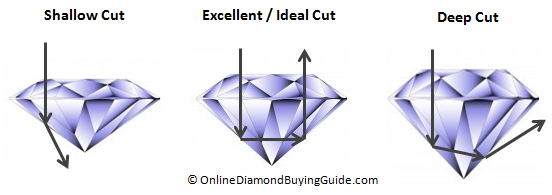
The answer is it has everything to do with the Cut of your diamond. The better the Cut, facet alignment and proportion, the more light will be coming out through the top of the diamond to your eye.
GIA (Gemological Institute of America) the foremost diamond grading and research laboratory in the world is debuting its new Cut Grade for round brilliant shape diamonds on January 1, 2006. Based on extensive research over fifteen years the new Cut Grade will appear on it's Lab Grading report. Cut Grades will range from Excellent to Poor.
In it's research, GIA considered, evaluated, and measured all 58 facets that compromise the round brilliant shape.

Facets that comprise the round brilliant diamond.
The grading system takes into account the entire diamond including the Table, Crown, Pavillion, Stars, upper and lower girdle facets, and culet size.
Cut Grade will range from Excellent to Poor and Girdle Thickness will factor into determining the final cut grade. In order for a diamond to get an "Excellent", girdle thickness will have to be in the range of 'thin' to 'slightly thick'.

Cut Grade Designations.
Girdle thickness will play an important consideration in assessing the final Cut Grade. This is so because many times in order to reach a target carat weight, a cutter will leave a thicker girdle in order to retain more weight. This will necessarily come at the expense of light performance and diamond beauty.

Evaluation of Final GIA Cut Grade based on Girdle Thickness.
The Cut Grade is based on rounded averaged values in the folllowing way:
Total depth is rounded to the nearest 0.1%
Table size is rounded to the nearest 1%
Crown angle is rounded to the nearest 0.5°
Pavilion angle is rounded to the nearest 0.2°
Pavilion angles ending in odd numbers are rounded UP to the next even number.
Star length is rounded to the nearest multiple of 5%
The lower-half (lower-girdle facet) length is rounded to the nearest
5%.
If you're considering a diamond that is not GIA graded you will need either a Megascope or Sarin Analysis Report which will provide you with the measurements for the Star, upper and lower girdle facets, which you can then enter into the GIA Facetware calculator along with the other numbers to determine the Cut grade.
The broad range in numbers rounding by GIA was based on the variances they found in measuring devices currently on the market and the observable differences in cut quality that could be distinguished by laypeople and tradesmen in the course of their research. No doubt this broad range may very well take an "Excellent" into a "Very Good" despite the certainty that a visual difference will not be discernable. What effect this will have on prices remains to be seen.
Attached are illustrations of the different facets in a round brilliant diamond used by GIA to calculate the Cut Grade as well as their Facetware interface and Cut Grade definitions. Also included is a Megascope Cut Analysis with the Star facet values and the lower girdle facet values highlighted.

GIA Facetware Calculator to obtain Your Final Cut Grade. If you're considering a diamond that has not been graded by the GIA, you will need a Sarin or Megascope Cut Report for some of the requested measurements.
Below is am example of a Megascope Cut Analysis report providing the measurements to plug into the GIA Facetware calculator.

Consumers will definitely benefit from this new Cut Grade system.
Will I See A Difference?
A question we have been asked quite often, recently, is whether it is possible to "see" a difference in a diamond that has been graded with 'Very Good' (VG) Symmetry" compared to a diamond given a Symmetry Grade of 'Good' (G)?
First, what is Symmetry? Symmetry refers to the "meet points" or junction lines that align the top (Crown) with the bottom (Pavillion) of the diamond. See Figure below:

Diamond Symmetry.
The red arrows show the meet points and junction connections between the facets. When the meet points are exactly aligned the diamond will receive a Symmetry grading of Excellent or Very Good. If there is just a tiny deviation, then it a Symmetry grade of 'Good' is given.
These minute differentials can most always only be seen under microscopic magnification and is not something you will see just by looking at the diamond.
Very Important Information When Considering a 'Modified Square Diamond'
First an overview:
1. Princess Cut diamonds have always been the 2nd most popular diamond
after round diamonds.
2. Princess Cut Diamonds have traditionally been popular as a result of their elegant square shape.
3. Princess Cut Diamonds have traditionally leaked light like a sieve from its 4 points (corners)
4. It is very difficult to harness and refract maximum brilliance from a traditionally cut (4 cornered) princess cut diamond.
-----------------------------------------------------------------------
In todays market place with consumers becoming more savvy and insisting on only the finest cut diamonds, some manufacturers have dealt with the aforementioned facts by producing new fangled modified square diamonds with tapered corners, all of which look almost identical to one another save for hype and marketing. These modified square diamonds have more brilliance than traditional princess cut diamonds as a result of the tapered corners.
Our company chose instead not to reinvent the wheel but rather to stay with the timeless (un-altered) 4 cornered princess cut diamond and just figure out a way to maximize its light performance.
Here is an article we published on our website to introduce our Signature Princess Cut Diamonds:
http://www.exceldiamonds.com/education/diamonds/superbcert-princess-cut.php
Over time we have been asked again and again by customers searching for that perfect square diamond while trying not to compromise on beauty and brilliance, why it is that we chose to go this route instead of offering some of these modified square diamonds.
We argued that these new fangled 'princess cuts' while achieveing better light performance than the traditional princess cut diamond did not look anything like its elegant predecessor. Moreover we argued that the timeless allure and appeal (even in the face of sometimes blatant light leakage) of the traditional princess diamond has everything to do with its shape and facet structure. This is mitigated the minute the corners are lopped off.
It was our opinion that all of these funky modified squares that were being introduced everyday by the dozens (and often by the same manufacturer with slightly different marketing and different romantic names..) would have very limited staying power and would be "here today & gone tomorrow".
We wondered how a consumer would feel about buying into all the hype surrounding a certain modified square diamond being touted as the end all and be all in "square diamond look-alikes" only to see that "brand" become obsolete a short while later, replaced (perhaps even by the same Mfgr.) by a 'new generation' diamond...'better than the last'. Indeed history has proven us to be correct.
We pointed out that by definition, these diamond manufacturers would constantly be replacing these 'brands' with new modified squares and new marketing so as to stay fresh and current. To the consumer (and often even from a structural point of view) however, these diamonds would all look exactly the same. Again, history has proven this to be the case.
Finally, we questioned how it is that any authorized diamond seller for these brands could offer in good conscience a diamond lifetime upgrade on these stones given the fact that these diamonds would in all likelihood be replaced within a short period of time by a 'new generation' cut, or fade completely into oblivion. Certainly the manufacturer of these diamonds would not honor an upgrade policy created by any vendor for these diamonds???
For all of these reasons and more, we opted for a project of increasing light performance in traditional square diamonds. From this was born our SuperbCert Signature Princess Cut Diamonds.
Exactly 1 year ago we published an excellent case study that we conducted on this topic regarding the "Regent, Queen of Hearts, and Jubillee Diamonds manufactured by The Horowitz-Atlas Group in N.Y.C. This case study was published right here on our diamond blog. Here is the link:
http://www.diamondvues.com/archives/2005/01/ags_diamond_lab.html
These words were truly prophetic as just earlier today a thread was started on a different diamond forum entitled "NO MORE JUBILEE?" where a customer asks why it is that the Jubilee which was touted as the very best in modified square diamonds (and the best thing since sliced bread..), seems to have disappeared off the face of the diamond map with no way of purchasing one.
Here is the response by an authorized diamond vendor for this brand on that thread:
"Hi All,
Yea ... during the past few months getting certain Jubilee's has been akin to pulling teeth and to my knowledge the developer and manufacturer has not been cutting product. We temporarily pulled the shape from our stock until the developer finds a new source for cutting them. I am told he is seeking a new cutter for them. Once they are back in production we'll announce it via our site. The Square H&A's and Regents are the best alternatives at this time with no compromise in optics."
So now the square H&A's and the Regent Cut Diamond previously replaced by the Jubilee (The Regent Specifically) which was promoted as being better than... is "just as good" presumably because there are still some of these stones left in circulation.
This is why we have always advocated staying with traditional diamond shapes when it comes to purchasing a princess cut (square) diamond. You don't want to purchase something of this magnitude that will not withstand the tests of time.
We feel this is a very important topic for anyone who is seriously considering the purchase of a princess and/or modified princess cut diamond.
Knowledge is the power to buy informed, and fore-armed is fore-warned.
Judah
Diamond Fluorescence Revisited: What Consumers Need to Know.
We have recently received many questions from consumers pertaining to the effects of fluorescence on a diamond's face-up appearance. There is still much confusion, uncertainty, and just plain mis-information being disseminated by fellow tradespeople as well as "internet forum lay-experts" on this subject. Fluorescence in diamonds is mistakingly thought to be all bad. This is not the case.
We therefore deem it helpful to all of you consumers to once again post a link to THE definitve study done on this subject back in 1997 by GIA scientists. This experiment is an excellent case-study on how to properly conduct a study with proper scientific protocol and procedure and will certainly bring particular joy and satisfaction to Engineers and fellow scientists for the way this experiment was conducted.
The results obtained by GIA scientists will startle and surprise you.
The link is HERE:
1997 GIA Study on Fluorescence
Whatever Happened to The Jubilee Diamond?
On a diamond internet forum today someone asked whatever happened to the much hyped Jubilee Diamond? This modified square shape was introduced to great fanfare as being the pinnacle of light performance for those preferring the square shape stone.
What may have really happened is this cutter has decided to stop manufacturing the Jubilee due to the fact that achieving this cut level is very time-consuming and not financially worth it. Cutters are paid by the carat weight piece of diamond rough they are working on and the more time they have to spend working on a given piece of diamond rough in order to achieve the specs of the Developer, the less real money they earn. Cutting a diamond to "Good" Symmetry and Polish as opposed to Excellent or Ideal Symmetry/Polish allows for more rapid turnover and completion of cutting projects and viable earnings. The developer of the Jubilee is now actively seeking a new cutting firm. With the ever increasing prices of diamond rough and decreasing profit margins at retail, we predict it won't be easy finding one.

Jubilee Diamond
The real question now becomes what happens if the production of the Jubilee does not resume or even if it does resume at a sporadic production pace. Where does such a scenario leave consumers who have already purchased Jubilees and wish to avail themselves in the future of the upgrade policy that many Jewelers and Internet vendors provide. Will they be able to do so if there are no bigger Jubilees to upgrade to? With a shrinking market and popularity due to decreased supply, will the Jeweler/Vendor honor their Upgrade Policy if they no longer have a re-sale market?
With increasing competition for the consumers diamond dollars and the growing popularity of buying a diamond from Internet diamond websites, several members of the Diamond Industry seek to re-invent the wheel by introducing new fangled shapes and marketing campaigns to sell them. Introducing a new product and making it stick is not easy.
We covered this scenario in depth in a recent DiamondVues Blog entry here:
New Diamond Shapes: Success Or Bust?
Just to test your diamond knowledge, here is a very partial list of diamond cuts that have been introduced to the market in recent years. Can you identify them and tell if they are popular sellers?
Ashoka Cut
Amorillion Cut
Asprey Cut
Asscher Cut
Baguette Cut
Baguillion Cut
Barocut Cut
Briolette Cut
Buddha Cut
Christmas Tree Cut
Context Cut
Corona Cut
Can you correctly identify any three?
GIA Or AGS Graded Diamonds? Take Both.
Recently on various diamond forums I see certain diamond experts getting their pants up in a bunch with all kinds of lengthy polemics even Albert Einstein wouldn't understand as to which diamond grading lab is considered to be the end all and be all. The two labs in question are the GIA and AGS. Certain flaws on the part of both labs are pointed out to support an argument one way over the other. What everyone agrees on however, is that both of these labs are the top two diamond laboratories in the world. Any loose diamond accompanied by a grading report from one of these labs is your assurance of only the highest and strictes standards for diamond grading.
In reality, it really doesn't have to be made so difficult. We're not talking rocket science.
Here is a rather simple break down:
Every loose diamond that you are considering for your purchase should be accompanied by a grading report (or diamond certificate) from an Independent grading laboratory whose job it is to ensure that you are getting what you paid for.
Many labs are incompetent. Other "labs" are really some guy in the back of the diamond store printing out cards with arbitrary grades given to each diamond. Usually these diamond color, diamond clarity, and diamond cut designations has you paying more for considerably less.
The strictest and most respected diamond grading labs in the world are the Gemological Institute of America and the American Gemological Society.
There is however one key difference between these two labs.
GIA until recently did not issue a diamond "cut grade" while AGS has been issuing cut grades for diamonds going back quite some time.
The coveted GIA certifed diamond has always been the GIA EX/EX or Excellent/Excellent for diamond polish and symmetry.
The coveted AGS certified diamond has always been the AGS-0 (or AGS-000) indicating ideal cut diamond proportions for all measurements.
As to the question of which lab is better? The answer is they are both excellent.
A loose diamond graded by the GIA or AGS is more valuable then any other "certified" diamond of dubious distinction. You are assured that a loose diamond graded by any one of these labs is exactly as described.
An AGS-0 loose diamond or a GIA certified EX/EX diamond will BOTH be visually beautiful and brilliant to the eye. Ultimately this is what really matters to the customer. All of the other nitty gritty permutations and considerations are moot.
Finally, for those who would like to know how a loose diamond measures up on both the AGS and GIA scale, there is a simple solution; get both.
I'm not suggesting here that a customer ask for two diamond certificates, that is ridiculous and unwarranted.
What I am suggesting however is that you can get a GIA certified EX/EX diamond and also ask for a sarin, or MegaScope analysis of your diamond which will give you an indication of the AGS score for the stone. You will see clearly whether the diamond in question qualifies as a true AGS-0 or not.
There are many diamond companies and websites that offer all of this comprehensive information up-front to their customers without you having to ask for it. It is always advisable to seek out a company the provides this level of data and full disclosure on all of their loose diamonds.
Thus, you can have your cake and eat it too!
For more information on the actual cut parameters and differences between the AGS and GIA models, here is an excellent link.
Isee2 Diamond "Beauty Evaluator"....What A Scam.
People have been asking us about the Isee2 Machine which ostensibly measures a loose diamonds brilliancy on a performance based assesment scale (Isee 2).

Isee2 Machine
On the surface of things this new technology seems pretty cool.
Certainly cannot hurt to use this machine with all of the other scientific tools we use to evaluate and measure diamond beauty and cut precision, no?
NO.
What many diamond shoppers do not know is that this machine was engineered and created by this company for the expressed purpose of promoting, marketing, and selling Ideal Cut Diamonds of their own exclusive manufacture.
In order for any company to "lease" the Isee2 diamond machine, a requirement to buy this company's (overseas diamonds) ideal cut diamonds for stock is placed upon the diamond vendor. This arrangement is a yearly agreement to the tune of hundreds of thousands of dollars.
Ever hear of the proverbial expression "the fox is guarding the henhouse"?
Certainly a "scientific" company that puts out a product for measuring and assessing diamond beauty, should not have a vested interest in doing so for the (expressed) purpose of selling their own goods....clearly a conflict of interest.
Additionally, besides for a fluff piece here and there regarding what the machine does, there is absolutely no hard data on exactly how this machine evaluates brilliance in a loose diamond.
NO faq's
NO peer review
NO independent review by any major industry authority
NO information
YES - Clear conflict of interest.
Sounds like a raw deal to me.
Bottom line is that the isee2 measurement for loose diamonds is much to do about nothing.
GIA Cut Grade for Round Brilliant Shape Defined.
The GIA (Gemological Institute of America) the worlds foremost diamond grading laboratory introduced their new Cut Grade system for round diamonds on January 1, 2006. This new cut grade system is based on 15 years of intensive research which included sophisticated computer modeling and over 70,000 human observations of diamonds differing in cut quality and measurements.
The new Cut grades are divided into the following categories:
Excellent
Very Good
Good
Fair
Poor
99% of the diamonds graded by the GIA will fall into one of the top three categories.
On March 10, 2006 Tom Moses issued a release further defining the parameters of the new GIA Cut Grade. I have reprinted his comments in their entirety below in order to give you consumers a better understanding of this new Cut Grade system and how it may help you in your purchasing decisions.
From the GIA website, 3/10/06.
March 10, 2006
From the GIA Laboratory: Six Defining Qualities of the New GIA Diamond Cut Grading System
"With the announcement and subsequent launch of the GIA Diamond Cut Grading System, I am frequently asked to explain the benefits of our system. Over the last several months, we have tried to address this and other aspects of the new cut grading system during the many presentations we have given on it, both domestically and internationally. At this time, I would like to share some of what we have presented.
The defining qualities of the GIA Diamond Cut Grading System are:
1. The system is Scientific. It rests on a foundation of peer-reviewed research, which included computer-modeled light behavior and statistical analysis of observations by members from all sectors of the international diamond community. Rather than starting with preconceived notions of which proportions and other factors lead to beauty and high cut quality in round brilliants, we used custom-designed computer ray-tracing and extensive observation testing to explore broad areas of proportion space. During the course of this methodical process, we scientifically proved what many in the industry had long felt about good proportions in round brilliants, but also discovered areas of proportion space that many in the trade never suspected could produce quality diamonds.
2. The system is Practical to use. It is visually intuitive—attractive diamonds receive favorable grades and unattractive diamonds are described as such. We also carefully considered what the “right number” of grades should be in a practical system—and arrived at five (excellent, very good, good, fair, and poor) based on the limitations of visual discrimination. The visual basis of the system also allows it to be taught (and learned) easily in our Education courses, and experienced members of the diamond trade can quickly see that GIA cut grades make sense and are easily understood.
3. The system is Comprehensive. Face-up appearance may be the most important part of a diamond cut grading system, but it is not the only part that should be considered. Our new system also includes aspects of physical design (such as weight and durability) and craftsmanship. All of these factors are considered in the determination of a final, overall cut grade.
4. The system acknowledges personal and regional Tastes and Preferences. One of the most compeling findings from our observation tests and interviews was that different people prefer different appearances in diamonds. Sometimes these differences are from one person to another, and other times they represent preferences in certain countries or regions. We knew that the GIA Diamond Cut Grading System had to be applicable around the world. In some cases, this meant recognizing that a certain face-up appearance might be favored by some but not others. This recognition, backed by the findings of our ray-tracing and observation tests, is incorporated into the final system. Even though there can be different appearances within a given GIA cut grade (a good thing from both a sales and consumer point of view), the overall performance (e.g., the brightness and fire) of each diamond with the same grade is similar.
5. The system is Predictive. Manufacturers, whether polishing a diamond from rough or recutting a polished diamond for a better grade, need to know before they start what cut grade they can expect from a certain set of proportions. The GIA Diamond Cut Grading System allows them to do this by using any of the GIA Facetware™ products—the free online Facetware Cut Estimator and Facetware Look-Up Tables, or the Facetware Database as embedded in non-contact measurement devices (such as those offered by Sarin and OGI).
6. Last, but certainly not least, the system is Accessible. Consistent with GIA’s status as a public benefit corporation, we have made the system available to anyone who wants to use it. To this end, we have developed software (GIA Facetware) that predicts cut grades and is available in several different formats, as described above. We have also dedicated a whole section of our website to presenting relevant information about the GIA Diamond Cut Grading System. In addition, since we announced the system in August of 2005, representatives of GIA Research and the Laboratory have been offering presentations at trade shows and in major cutting centers in the United States and internationally. Starting in January, GIA Education began teaching students how to use the new cut system in half-day seminars, and it now includes this instruction in all new diamond-related course material. Everything needed to use and understand the new cut grading system is readily available.
We are confident that we have created a diamond cut grading system for round brilliants that is accurate, complete, and practical. It is a system that can be used and understood by the public to make informed buying decisions, and by manufacturers to maximize the beauty from rough. For more information about the new system, please visit our diamond cut microsite. www.gia.edu
Thank you,"
Tom Moses
Senior Vice President, GIA Laboratory and Research
Want To Learn All About Diamonds? Buy This Book.
This comprehensive Diamond information book by the Diamond Council of America is considered one of the most effective training tools available for diamonds and diamond education.
Whether you are a novice looking for a diamond education, or a professional jeweler looking to polish up on your sales skills (especially with those saavy diamond internet shoppers :) ) this book is for you.

Here is the link:
Diamond Identification Method for Consumers: Bring Napkins
The Financial Times of London reports on a novel way to identify Diamonds from fakes:
It is said that Alexander the Great found a valley full of both diamonds and poisonous snakes. No one could work out how to retrieve the jewels until Alexander had the idea of throwing down raw meat, to which the diamonds attached. When eagles flew down for the meat, Alexander's men just had to follow them to their nests.
It sounds like fantasy but diamonds are attracted to fat, and the story reminded people how to tell real diamonds from fakes. De Beers still practise Alexander's trick in their South Africa mines today: They use "grease tables" and only the valuable stones stick.
Today, most engagement rings are diamond but after the war, people wanted holidays, cars or colorful gems to celebrate a future marriage.
In 1947 a New York copywriter, given the task of finding a slogan for her client's product, stayed late in the office. "I put my head down and said: 'Please God, send me a line.'" Then she scribbled: "A Diamond is Forever" and the rest is History.
Buying Loose Diamonds, Engagement Rings, Wedding Bands, & Wedding Rings: Trust and Verify.
Marshall Loeb of Market Watch quotes our friend and colleague, Jay Mednikow with advice to consumers on how to safely shop for loose diamonds, engagement rings, wedding rings and bands, both in jewlery stores and through internet websites. It is advice we agree with 100% and worth following.
Few purchases are more mystifying for first-time buyers than fine jewelry. There's more information out there than ever - from jewelers' Web sites and online forums to nearly ubiquitous grading reports from independent labs. But buying expensive gems and precious metals is still largely a matter of trust between you and the jeweler.
First, educate yourself on the basics. For diamonds, that means the four Cs: cut, color, clarity and carat weight. For gold, platinum and silver, it means purity.
You can find helpful information on these fundamentals from the Federal Trade Commission ( FTC) and the Better Business Bureau (BBB). The Gemological Institute of America, the most prominent diamond grading agency, provides tutorials on buying diamonds and colored gems at (GIA Education).
"It's less of a blind purchase than it used to be," says Jay Mednikow, president of 115-year-old Mednikow Jewelers in Memphis and Atlanta. "But a jeweler who knows what he's doing can take advantage of you if he wants to."
Thus, there is still no substitute for a reliable dealer with an established reputation. Many jewelers are GIA-certified gemologists and display their credentials prominently.
For diamonds, Mednikow recommends buying only those with grading certificates from GIA, the American Gem Society or another independent laboratory. If a jeweler says he can offer you an uncertified diamond at a discount, tell him you'll pay to have it analyzed since the cost should be only $50 to $300 depending on the size of the stone. Read warranty and return policies carefully and make sure all guarantees are written on your sales receipt - it's your legal contract.
You may have a hard time distinguishing between slight variations in color and clarity, but still trust your own eyes.
Mednikow recommends holding diamonds with a pair of tweezers over your finger or against a white background and under lights of different types and varying brightness. With shapes other than round-cut, which has standard specifications, and with colored gems, you will have to rely much more on the jeweler's expertise.
If you are buying a colored stone such as a ruby, sapphire or diamond, ask if it has been "treated" to enhance the color. Some processes are routine, like heating for sapphires and rubies and oiling for emeralds, but others are temporary or undesirable.
Up to half the gold jewelry sold in the U.S. bears a false karat rating, says Mednikow. Choosing a reliable merchant is your only insurance, although national retailers like Zales and Sears are diligent about the purity of their gold.
Loose Marquise Diamond Shape: What to Look For.
The Marquise Brilliant takes its name from a legend that the Sun King desired a stone to be polished into the shape of the mouth of the Marquise of Pompadour.
The Marquise Brilliant is a boatshaped modified brilliant. It is generally agreed that a length-to-width ratio between 1.75:1 and 2:1 is most pleasing. As with other fancy shapes, a certain degree of what constitutes a beautiful shape has to do with the consumer's individual taste. The ultimate shape of the finished diamond is determined by the rough and what parameters it allows. The typical Marquise Brilliant contains 56 facets.
Of concern to consumers when evaluating a marquise shape diamond is the appearance of a visual pattern called a "bow-tie" which looks exactly like that, right in the center of the diamond. It is true that an extreme bow-tie can be jarring and unattractive to the eye, but some amount of bow-tie is beneficial to the visual appearance of the diamond as it provides contrast brilliance and makes the stone stand out in sharper detail.


Minimal bow-tie indicated by the arrows.
An example of a beautifully cut marquise diamond is shown below.

Diamond Hunting: You Can Do It.
Want to prospect for your own diamonds? Pamela Selbert tells you how to do it!
Finding Your Diamond In The Rough: Here's How!
What To Look For When Buying an Asscher Cut Diamond!
I just spent the past hour doing a photo workup on an absolutely stunning Asscher Cut Diamond for one of our customers. Let me tell you something; Asscher cut diamonds are very tricky due to the nature of their construction. Unlike a 58 faceted round brilliant diamond, or even a princess cut diamond, there are many fewer facets carved into the Asscher Diamond (also known as a step cut diamond...). As a result of this construction, the diamond appears very glassy and will discriminate against lower colors and clarities with the inclusions visible and the coloration very obvious to the naked eye.
Therefore, it is of paramount importance when buying this kind of diamond shape to purchase (at the very least) a diamond of white color grade, excellent clarity grade, and hopefully a well cut stone. Otherwise, the diamond will look like the "black hole of Calcutta" and you will be miserable. More details about the Asscher here: Asscher Diamond Specs.
However, when you do some research and purchase a well cut Asscher cut diamond....let me tell you..they are absolutely smoking!!!
Take a look at this absolute beauty I just finished photographing!

Beautiful Asscher Cut Diamond by www.exceldiamonds.com
Loose Baguette Diamond: What Is It & What To Look For.
A straight baguette is a relatively small, elongated diamond that usually is rectangular in shape. The cut is characterized by square corners with rows of step-cut or steplike facets parallel to the table. Baguettes do not conform to the Federal Trade Commission's" 17 -facet" requirement for diamonds.

Straight Baguette.
The name of the cut must proceed the word diamond. Baguettes today are most often employed as side stones, although they also can be the main shape in full-band rings or fashion rings. When used as side stones they serve to camouflage the shoulders of the center stone, masking it £rom the girdle to the culet. Baguettes can also be lined up to produce a continuous flow of diamonds on a ring, bracelet, brooch (i.e. circlet) or necklace.
Baguettes are usually channel-set, but sometimes prong set. Less-expensive baguettes are often channel-set into bracelets. Measured in millimeters more often than weight because their size must be precise for their function, typical sizes for today's side baguettes are from 1.5 mm to 3 mm in length. For larger, more important pieces, designers and retailers may order straight baguettes of 2.7 mm to 4.7 mm, for example.
The word "baguette" is a French word for a long, narrow loaf of bread. This shape, beginning in costume jewelry, is a fashion outgrowth of the 1920s to mid-1930s. During that time, interest in functionalism in architecture and the Bauhaus movement influenced the applied arts and dominated contemporary design. In the Art Deco period, many stones were cut in strict, geometrical shapes, typified by the calibre technique or elongated baguette. In contemporary times, jewelry houses like Bulgari have sustained their use and passion for the baguette. Nicola Bulgari once exclaimed, "We flirt with the baguette." The yield for a baguette from the diamond rough is 38 to 42 percent.
Baguettes are extraordinarily clear. If baguettes are to be used as side stones or as other matched pairs, they must be of similar quality, color and clarity to one another, and to the stone they are enhancing. The step-cut appearance is unforgiving and does not allow for little imperfections in the diamonds. Stay with VS clarity and higher. SI clarity must be examined to insure that the imperfection(s) are not eye-visible. A small chip is much more obvious on a baguette than on a heavily faceted diamond.
Loose Cushion Cut Diamond: What Is It?
The Cushion Cut is a generic name for the Old Mine Cut developed before the turn of the century; these days the name" cushion" is often used for colored stones cut in this shape.
A Cushion Cut is a square or squarish-rectangular cut with rounded corners and 58 brilliant-style facets that resemble a pillow shape, hence the name.

A hundred years ago, when Cushion Cuts were first developed, diamonds were not cleaved into two pieces of rough, as they are today; they were ground down as a single stone and the resulting polished was lumpy and thick. Cushion Cuts have very thin girdles and bigger culets than today's full-cut diamonds.
Designers are requesting Cushion Cuts with big culets, but, in general, the smaller the culet, the better the stone. Older Cushion Cuts return light in blocky patterns; newly cut ones return light in needlelike patterns.
MARKETS AND MARKETING
Cushion Cut diamonds are popular in matching pairs. They are especially being used in larger-carat earrings and also as a center stone in rings. Cushion Cuts first became popular again about ten years ago, and their popularity has increased as designers and antique dealers continue to use them.
Cushion Cuts offer a lot of weight at a moderate price. Larger Cushion Cut diamonds sell for about 30 percent less than full-cuts of the same weight, while smaller cuts sell for about the same. A 1-carat G/VS Cushion Cut stone will sell from $2,800 to $3,800. Two-carat and up stones sell in the $3,500 to $5,000 per carat range. The most popular sizes are .75 to 1.5 carats. The availability of 2-carats and up is a problem because of the high demand for larger stones, both by estate and antique dealers for replacement or repair and by manufacturers.
Look for good clarity and color. Because Cushion Cuts have very thin girdles, girdles on older ones are often chipped. Look for Cushion Cuts that are symmetrical; off-shape ones are difficult to use. Look for a medium culet that is not too heavy, unless you have a special reason to use this cut with a big culet. Pick a mounting that's appropriate for the softer reflections and refractions of a Cushion Cut. Old Mine Cuts were traditionally set in yellow gold or silver with a patina or oxidation; therefore, they look better set in matte metals rather than highly polished ones.
Engagement Ring Purchase onThe Internet: Is This A Good Deal?
Is the question being asked by a consumer this morning on Diamondtalk.com. He has seen a Princess Cut that is being listed on EIGHT different internet diamond websites at different prices!!
Discussion is here: Good Deal?
Here are the multiple listings for this one diamond:
Who really has this diamond?
2.23 I VS1 71.7% 72% GIA med-stk no gd vg no 7.42x7.27x5.21 $6209 $13847*SP
2.23 I VS1 71.7% 72% GIA med-stk no gd vg no 7.42x7.27x5.21 $6262 $13964SP
2.23 I VS1 71.7% 72% GIA med-stk no gd vg no 7.42-7.27-5.21 $6276 $13996*
2.23 I VS1 71.7% 72% GIA med-stk no gd vg no 7.42x7.27x5.21 $6291 $14029
2.23 I VS1 71.7% 72% GIA med-stk no gd vg no 7.42x7.27x5.21 $6306 $14062*S
2.23 I VS1 71.7% 72% GIA med-stk no gd vg no 7.42x7.27x5.21 $6308 $14066*SP
2.23 I VS1 71.7% 72% GIA med-stk no gd vg no 7.42*7.27*5.21 $6339 $14136*S
2.23 I VS1 71.7% 72% GIA med-sl thk no gd vg no 7.42x7.27x5.21 $7198 $16051
This diamond is supplied by the manufacturer to many internet websites and is known as a "Virtual Diamond".
Little if any information is provided save for a few numbers off the lab grading report and the price. You are buying blind.
We have blogged on this topic several times. Same Diamond Listed All Over The Internet?
Virtual Diamond (VD) databases do not give you the necessary information you need, e.g.; photo's, Imagescopes, and light performance data such as provided by the Gemex Brilliancescope. As such, these lists are useless. Would you buy a Home this way? I doubt it. Why should your diamond purchase be any different. It's also big money.
This is a big purchase not only because of the money, but even more so because of the emotion and psychology behind it. You need to get this right the first time. Work with Internet websites that give you comprehensive information.
"Diamonds Are For Ever", But Are Diamond Mines?
Cramer's Mining Weekly reports that the slogan "Diamonds may be forever", but the same cannot be said of diamond-mines.
While De Beers Consolidated Mines (DBCM), the largest producer of diamonds in South Africa, produced a record 15,2-millioncarats last year, it estimates that it will produce just over 14-million carats this year.
Part and parcel of new DBCM MD David Noko’s strategy is to sweat the company’s existing assets, and bring new, additional production on line.
“I do not think that we can grow production from our existing operations – we just can’t.
“Our installed capacity is fixed, and we need capital to improve it,” Noko, who was appointed as DBCM MD on February 7, tells Mining Weekly in an exclusive interview.
And, gaining approval for brownfield projects that do not meet the hurdle rates of the company’s principals is out of the question.
“There would be no point in injecting capital into declining mines like The Oaks, as a return would not be realised, but, by exception, all opportunities are being explored, the major ones being brownfields, but some being greenfields through finding partners that have large resources,” Noko says.
Hence, besides organic growth projects, DBCM’s growth strategy is levered on partnerships with smaller diamond-mining companies.
“If we partner with smaller companies, they will benefit from our knowledge, while we will benefit from the resources that they have acquired,” Noko says.
DBCM has many partnerships in Kimberley, where it has large tailings dumps that require advanced technology to turn the low grades of diamonds that they contain to proper account.
The company is also continuing to research the opportunities of working with junior miners and, in Kimberley, already 25% of revenue emerges from joint ventures with junior miners through contracts.
Tiffany's Lucida Diamond: What is it ?
Tiffany & Co.'s Lucida is an exclusive patent pending diamond cut whose shape is a square mixed cut. It has 50 facets, a high crown, stepped facets, wide corners and a small table with a brilliant pavilion. The design of the cut maximizes the stone's sparkle and brilliance. A photo is shown below.
AGS-0 Ideal Cut Princess Diamonds have similar sparkle to the Tiffany Lucida, without the price tag!

Lucida Diamond.
Tiffany has added an eternity band and a three-stone ring as well. Lucida, which means the brightest star in a constellation, is available exclusively at Tiffany & Co. stores worldwide. The setting is copyrighted and the diamond has multiple patents pending.
The Lucida diamond is made from the same rough as a well-cut round. Created by Tiffany's gemologists, the cut is similar to the Asscher and antique Cushion Cuts. Tiffany showcases the Lucida cut in a special four-prong ring shown below. The sculptural band has clean lines and soft curves that merge with the prongs in a sloping crisscross design, which, when viewed from the side, is reminiscent of cathedral arches.

Lucida Ring.
Lucida was designed and introduced by Tiffany in 1999. The retailer has positioned the collection to fit between its classic Tiffany setting and its cuttingedge Etoile collection and has become something of a status symbol. The worldwide launch was backed by an extensive advertising campaign that included four-page inserts, spreads and single-page units in fashion and lifestyle publications. The Lucida is available at 150 locations internationally, including Japan, France and London.
Each Lucida diamond is sold with a Tiffany Certificate. The inside shank of each ring is currently engraved with the following: Copyright, Tiffany & Co. Lucida, metal fineness and the phrase "patents pending." When the patents are finalized, the actual patent numbers will be engraved in the shank.
Click on the icon below for a stunning collection of the finest Tiffany style diamond engagement rings and Ideal Cut diamonds at outstanding values!!
Chameleon Diamond: What Is It?
In Nature, Chameleons (family Chamaeleonidae) are large lizards that belong to one of the best known lizard families. They are famous for their ability to change their colour, and also because of their elongated tongue and their eyes which can be moved independently of each other. Their eyes are the most unique among the reptiles. Among other things they can rotate and focus separately to observe two different objects simultaneously.

Chameleon
Some Chameleon species are able to change their body colour, which has made them one of the most famous lizard families. Contrary to popular belief, this change of colour is not only an adaptation to the surroundings but also an expression of the physical and physiological condition of the lizard. The skin colour is changed under influence of mood, light and temperature. The skin colour also plays an important part in communication and rivalry fights.
There is also such a phenomenon as a Chameleon Diamond. Certain natural green diamonds react to heat or dark storage by temporarily changing color, often becoming bright yellow. This color change is short-lived as the diamond soon reverts to its stable color. Most specimens observed in gem laboratories show even color distribution, aiding in the dramatic transformation, and both color changes are documented on laboratory reports. Faceted chameleon diamonds of 2 carats or more occasionally appear on the market; the more sizable stones offer the maximum opportunity to see color change.
A color-change diamond is such a rare and curious gem that very little has been written on the subject. The first documented report on chameleon diamonds appeared in 1943, according to the GIA Diamond Dictionary. Peter Kaplan, of the Peter K. Kaplan Inc., was astonished to witness a diamond change color on the very hot polishing wheel. The peculiar diamond was later graded light yellow green. It sold, but the baffled customer promptly returned it for a refund when the yellow-green diamond changed to dark green after storage in a jewel box.
Phenomenon Not Well Understood.
An article in GIA's Award Winning Journal, Gems & Gemology, Spring 2005, acknowledged that “...the mechanism behind chameleon coloration is not yet well understood. Nevertheless, chameleons are among the few green diamonds that can be conclusively identified as natural color, since their behavior cannot be created or enhanced in a laboratory.”
Fine-quality phenomenal diamonds often carry certificates verifying their natural characteristics. One such report by Gübelin Gem Lab, Lucerne, Switzerland, added, “Chameleon diamonds are one of the great mysteries of the diamond world. It is still not known why these diamonds change from deep green to yellow when heated or left in darkness . . . these qualities make ‘chameleons’ among the most fascinating of colored diamonds.”
A rare subset of natural fancy color diamonds, chameleons are so named for their repeatable color-change property. Prolonged dark storage, or photochroism, changes a “Classic” chameleon from its typically stable color of grayish-yellow-green to a temporary or unstable color of greenish-orangish-yellow. A few hours of dark storage might be all that is needed to bring on a color change. Also, heating a Classic chameleon, termed thermochromism, likewise results in a prominent temporary color change. At about 150º C, the induced color should be evident within a few seconds. The term “Reverse” chameleon refers to phenomenal diamonds that change from yellow in stable conditions to green after subjection to dark storage. Heating does not produce a color change in Reverse chameleons. With both groups, the change is infinitely repeatable.
Rarer still are some “maverick” color-change diamonds that have been found in Australia that exhibit this phenomenon with their own unique pair of colors. Australia’s Argyle diamond mine, famous for its fancy color diamonds, occasionally produces hydrogen-rich diamonds that also exhibit a “chameleonlike” color-change behavior. The stones are distinguished by either a blue-violet-gray color or a gray-olive color. They are thought to owe their phenomenon to high hydrogen content, but this has yet to be proven.
Identification of Chameleon Diamonds is by heating and observation. Be careful with this because heating an enhanced diamond, however, might lead to an unwanted permanent modification of color. If you suspect that the green diamond might just be an enhanced stone, the recommended course of action would be to send it to a laboratory for testing. In a laboratory, the spectroscope reading, coupled with an ultraviolet (UV) radiation reaction, will positively separate a chameleon from another type of green diamond.
Rarity.
Because of their rarity Chamelon Diamonds are not well understood by the Public or by Jewelers. Chrisities, or example, auctions a color-change diamonds in Hong Kong, because, according to Daphne Lingon, senior vice president, jewelry department, the Asian market is well-informed about phenomenal gems,which are avidly collected. During Christie’s Magnificent Jewellery & Jadeite Jewellery Hong Kong auction in May 2001, a platinum ring featuring a 4.41-carat “superb fancy dark-gray-yellowish-green chameleon diamond” went on sale and brought a sale price of $240,000.
Online jeweler Ariel Friedman of IceStore Inc., Beverly Hills, California, speculates that a combination of phosphorescence and fluorescent properties contribute to the chameleon effect in these special diamonds. Friedman estimates that he sells between five and ten chameleons a year, attributing that success to his customers, who only buy high-end goods. Recently, one of his best phenomenal diamonds went to a well-known actor who desired a one-of-a-kind gem. Friedman’s clientele understands fancy color diamonds and that “with chameleons, they own something clearly unique among the fancy colors.” A 2.95-carat, round brilliant chameleon is offered on his website for $63,720.
New Diamond Mine Exploration Continues.
Reuters reports today that Angola’s state run diamond company, Endiama, has entered into a joint venture exploration partnership with Russia’s diamond company, ALROSA, to explore a new diamond concession in the province of Luanda-Norte. The two companies announced on April 21 that the project, named Cacolo, will survey a 4,000 square km area over a five year period..
As part of the agreement, ALROSA is obligated to invest a minimum of $14 million in the prospecting stage but said that the figure will likely be higher. "Preliminary data shows that the area has very good potential. It holds out lots of promise -- there should be Kimberlite pipes. If we find them it needs $200 million of investment," Alexanda Nichiporuk, president of ALROSA, told Reuters.
Endiama's communications director, Sebastiao Panzo, said that the deal was part of a broader strategy of attracting foreign capital to develop local resources. "Diamond expansion needs more capital. Angola has concessions on the one hand and on the other those who want to invest from the outside,” he said.
Angola's diamond production doubled to seven million carats in 2005 and it is expected to produce over 10 million carats by the end of 2006 as the government expands beyond traditional mining areas. "With diamond production stagnating in many parts of the world, demand is set to grow in East Asia and China especially, Angola's...concessions could be some of the most
Angola's diamond production doubled to seven million carats in 2005 and it is expected to produce over 10 million carats by the end of 2006 as the government expands beyond traditional mining areas. "With diamond production stagnating in many parts of the world, demand is set to grow in East Asia and China especially, Angola's...concessions could be some of the most lucrative in the world," Viascheslav Lapshin, vice president of ALROSA, told Reuters.
Endiama has a majority stake in the venture, ALROSA has approximately 39.5 percent and the remainder belongs to smaller local companies.
Belgian Gov't Reduces Taxes On Diamond Companies.
At the end of 2005, a new fiscal law was adopted that will make Belgium far more attractive to all companies doing business there —which means not only diamond companies, but firms from all business sectors and industries.
The principle of the new program relies on what’s been referred to as a “notional interest rate.” As of accounting year 2006, all Belgium-based companies will have the opportunity to calculate a totally fictitious interest rate on their equity. This interest rate — which is currently between 3.442 and 3.942 percent — will be deductible from the taxable profit, a measure that is likely to reduce the taxable profit of businesses to verylow levels. The effective tax burden, especially for larger capitalized companies, could drop from the usual 28 or 34 percent corporate income tax rate to the negligible figure of 6 percent in the best cases.
The new tax law does not have any stringent conditions — no employment condition, no investment condition, applicable to all companies, no limitation on activity — and will restore the balance between Antwerp and other competing diamond centers.
Kaushik Mehta of Eurostar Diamond Traders, however, has a different opinion: “It’s very good as you pay less tax. The notional interest will certainly help ease business in Belgium, but it’s still no match for Dubai, at least as far as their zero tax is concerned. Antwerp has other assets, such as a huge market, to compete with other diamond centers.”
The notional interest tax plan will also assist with respect to DeBeers Diamond Trading Company (DTC) and the Banks. The diamond industryr is typically a sector that requires large working capital and relatively small profit margins, and a substantial number of companies have capital booked as current account. Currently, this cannot be taken into consideration for the notional interest deduction and is booked as a loan. From this year onward, registration fees on capital increases of 0.5 percent are abolished and there is virtually no cost involved anymore in increasing the statutory capital. Therefore, it is useful to incorporate the loans/current accounts into statutory capital. This, of course, can substantially increase the equity of the company, which also results in an improved solvability toward third parties — this is equity against balance sheet total. Banks are, indeed, pushing diamond companies to move toward an equity of 15 percent-plus because traditionally the equity of Belgian diamond companies is very low. Also, for sightholders, DeBeers takes into consideration the financial strength of a company, which is reflected in the equity and solvability ratio.
Consequently, the larger the capital, the higher the amount of the notional interest deduction. This allows companies with larger capital to pay lower taxes on their profit and as a result have higher net profits, which, again, they can capitalize. The following year, the equity has grown with the increased net profits of the previous year on which the notional interest deduction is applicable. So, this creates a rollerball effect in which equities grow quicker and quicker and are constantly leveraged with the notional interest deduction the following year.
It’s been understood that the measure would also benefit smaller-size companies, depending on their degree of capitalization, as the law applies to all corporate entities. Percentwise, it can create the same result, but, of course, the nominal amounts are smaller.
The first cycle of the system will be completed within the year. Tax reduction is positive in that it spurs production and eventual tax revenue. The effects on consumer prices remains to be determined.
Asscher Cut Diamonds: Buy The Stone, Not The 'Numbers'
My Dad (Barry) just blogged here recently about the importance of buying the loose diamond itself and not merley a set of 'numbers' when it comes to purchasing your dream diamond engagement ring.
In today's (similar) project, we evaluated and photographed 2 loose Asscher Cut Diamonds on behalf of one of our customers.
Both diamonds are incredibly beautiful and brilliant for this type of fancy shape. Additionally, the prices on both diamonds represent an extraordinary value for these kind of quality diamonds. The difference in carat size is negligible and is virtually impossible to distinguish. Both diamonds face up exceptionally white and both are eye-clean.
Only one diamond however, is in our opinion clearly a better "value" (best bang for your buck) over the other.
This is simply because you get to save money for a difference that ONLY EXISTS ON PAPER (DIAMOND CERTIFICATE) BUT CANNOT BE SEEN WITH THE NAKED EYE.
I am referring here to the difference in color and clarity grades of the two diamonds which cannot be guaged with the unaided eye yet influences pricing based on the rarity factor and market forces.
From a qualitative and quantitative standpoint however, they are almost indestinguishable and equally brilliant to the eye.
Would some argue with us regarding our position on buying the "best value for your dollars"? Sure!
This is because buying a loose diamond is chock full of emotional and psychological variables that are always considered. It is a once in a lifetime purchase (we hope :)) for most, and some people need to go to sleep at night with the knowledge that they got their gal an incredibly rare D/VVS1 diamond engagement ring...
This is obvioulsy the approach and motivation of psychology and emotion over the rational and practical considerations in the diamond buying process.
This is a purely personal and subjective approach.
Our approach however is to always make sure that you get the best diamond that money can buy from the standpoint of cut precision and light performance. Once you secure this kind of ideally cut diamond, you don't need to pay the extra money for the "collection color/clarity grades" which DO NOT AFFECT A DIAMONDS BRILLIANCE AND DISPERSIVE QUALITIES ONE IOTA, AND ONLY TALKS TO THE RARITY OF THE STONE.
Want to decide for yourself?
O.K.
Here are the photographs of the 2 Assscher Cut Diamonds that we took today.
You decide which one is "better".
2.29 F VS2 Asscher Cut Diamond is $24,700
2.26 D VVS1 Asscher Cut Diamond is $35,500


Round Brilliant Diamond Shape: Some Notes.
GIA updated the wording and the placement of “brillianteering” comments on its Diamond Grading Report and Diamond Dossier® for standard round brilliant diamonds as of July 1, 2006.
GIA’s new Diamond Grading Report and Diamond Dossier®, in January 2006, indicated when a diamond’s cut grade was affected by painting or digging out by putting a notation within the report’s comments section that read: Cut grade is based on brillianteering of the half-facets.
As of July 1, this statement will be located under the proportion diagram –-not in the comments section-– that reads: Cut grade affected by brillianteering.
Brillianteering refers to the last steps of t